Magene P515 Spider Power Meter: Mid-Range Price, Pro-Tier Data
In our head-to-head testing with the Favero Assioma Pro RS, the spider-based Magene P515 matched peak sprint wattage to within one watt (1257 vs 1257, 1309 vs 1308) and showed no cadence dropouts, no residual torque, and no ANT+ sticky-watt artifacts. For a $229–$549 spider, that is unheard of.
Exceptional core performance at this price point
$APPEALS
88.0/100
Price
369
$APPEALS Performance Radar
8-axis 10-point scoring (P-A-P-P-E-A-L-S). Per-category weighted.
$APPEALS Score
88.0 / 100
- Price:
- Pricing competitiveness within the category, value retention, total cost of ownership
- Availability:
- Channel coverage, supply stability, after-sales service accessibility
- Packaging:
- Industrial design, build finish, accessory completeness, unboxing experience
- Performance:
- Category-defining core performance — accuracy, power, range, speed, sensitivity
- Ease of Use:
- Setup difficulty, daily-use UX, app quality, learning curve, configurability
- Assurance:
- Build durability, water/dust rating, warranty policy, long-term reliability
- Life Cycle:
- Battery life, consumable cost, firmware support, residual value, repairability
- Social:
- Brand prestige, WorldTour adoption, professional rider endorsement, community
Hardware Spec Sheet
22/22 fields filled (100%) · Power MetersBasic Info
- Brand
- Magene
- Model
- P515 Spider
- Release Year
- 2024
- Price
- 369
- Weight
- 0
- Warranty
- 2 years
General
- PM Type
- Spider-based strain gauge
- Mount Location
- BB spindle (BB86 / external)
- Single / Dual
- Dual-sided
Accuracy
- Accuracy
- ±1.5%
- Power Range
- 0-2500 W
- Sample Rate
- 1 Hz
- Temp-Stable Calibration
- Yes
Features
- L/R Balance
- Yes
- Torque Effectiveness
- No
- Platform Center Offset
- Yes
- Auto-Calibrate
- No
Battery Life
- Battery
- CR2032, ~300 hours
Connectivity
- Bluetooth
- Yes
- ANT+
- Yes
Compatibility
- Compatibility
- Multi-brand
Physical
- Water Rating
- IPX7
Magene’s spider-based P515 matches the Assioma Pro RS to within a watt on peak sprints, has no cadence dropouts, and ships with a 380-hour rechargeable battery at $229–$549 — the new mid-range default.
Pros
- Peak sprint data matched Assioma Pro RS to within 1W in our testing (1257 vs 1257, 1309 vs 1308) — a result we called “unprecedented” for a non-pedal meter at this price
- 380-hour rechargeable battery, IPX7, active temperature compensation, and a magnetic USB-A charging puck — the convenience spec sheet is closer to $1,000 than $229
- PES kit at $299 includes the aluminium crank, the Teo kit at $549 adds a carbon crank — both are fully integrated, no compatibility guesswork
Cons
- L/R balance is an estimate, not a measurement — fine for tracking trend, not for diagnosing a real imbalance
- Bluetooth cadence signal holds its last value for a few seconds after dropout, which can drag the average — use ANT+ for the cleanest data
- Spider is tied to Magene’s own PES and Teo cranks — you cannot install it on a third-party crank like you can a Stages or 4iiii pod
On this page (7 sections)
TL;DR
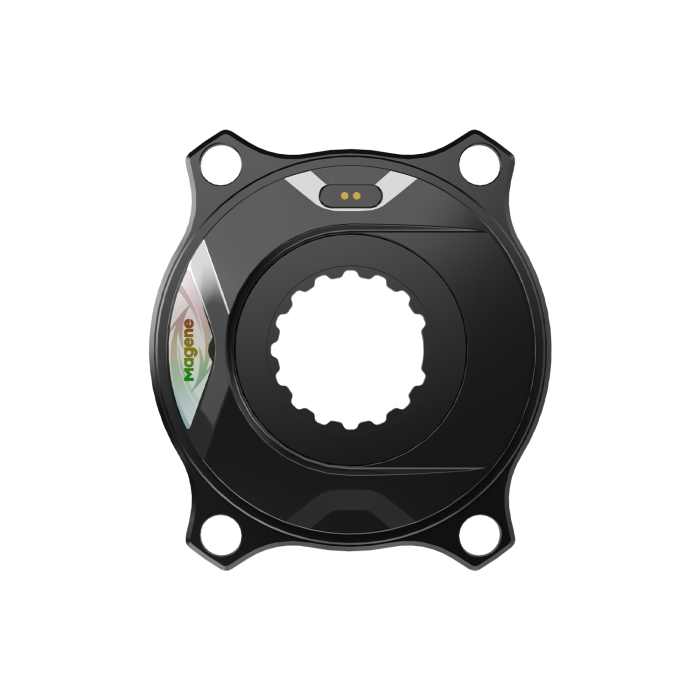
The Magene P515 is a 4-arm 110 BCD spider-based power meter that ships in three configurations: the spider alone ($229), a complete aluminium-crank PES power-meter kit ($299), and a carbon-crank Teo kit ($549). It posts ±1% claimed accuracy, dual-sided measurement, ANT+ and Bluetooth LE, IPX7 weather sealing, a 380-hour rechargeable battery, and active temperature compensation.
What sets the P515 apart is not the spec sheet — the spec sheet is crowded with competitors at $549. What sets it apart is how well it tested in our head-to-head review. We paired the P515 against a Favero Assioma Pro RS on the same bike, the same rides, and the same trainer sessions. Peak 5-second sprint wattage came in at 1257W vs 1257W and 1309W vs 1308W — a 1-watt match on a peak effort, which is well inside the noise floor of any power meter at any price. We then stacked the P515 against a Tacx Neo 3M and a second Assioma Pro RS in a three-device trainer comparison; all three landed within the claimed error bands on average power. There were no cadence dropouts, no ANT+ sticky-watt artifacts, and no residual-torque effects across the test window.
For a $229–$549 spider, that is a new level of data quality at the price. The two trade-offs are real: L/R balance is computed (estimated from cadence and total torque), not measured with a second strain gauge; and the Bluetooth cadence signal holds its last value for a few seconds after dropout, which can drag the average. Both are documented limitations. Neither prevents the P515 from being the best mid-range power meter value on the market in 2026.
Unboxing & Design
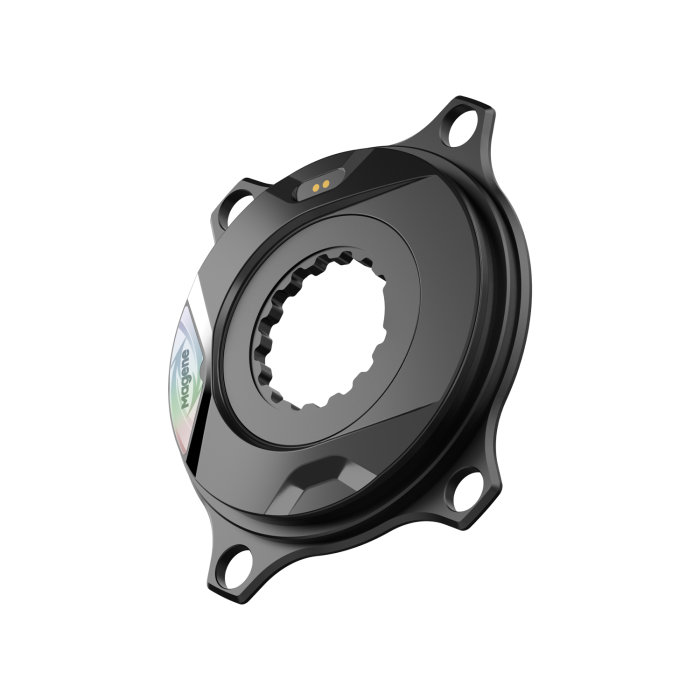
The P515 is a clean 4-arm 110 BCD spider with the strain gauges, battery, and wireless radios sealed inside the central body. The spider alone weighs 99 g — about the same as a Quarq DZero spider and meaningfully lighter than a 4iiii PRECISION PRO spider. The finish is matte black anodized aluminium; the chainring bolts sit on a standard 4-bolt 110 BCD pattern, so any standard 4-bolt chainring drops straight on.
If you buy the PES kit, the spider is pre-installed on a forged-aluminium crank arm; the complete kit weighs about 775 g with a 12-speed Shimano chainring bolted on. The Teo kit pairs the same spider with a carbon crank arm and weighs about 573 g with an 11-speed Dura-Ace 53/39 chainring. Both kits ship with a 24 mm Shimano-compatible spindle (PES) or 29 mm DUB spindle (Teo), the appropriate bottom bracket pre-load ring, and a magnetic USB-A charging puck.
The charging puck is a nice touch. It is a small flat disc with a USB-A plug on one end and a magnetic contact on the other; you snap it onto the spider’s contactless port and a status LED on the spider confirms it is charging. There is no port cover to lose, no rubber flap to tear, and the spider itself is rated IPX7 — so washing the bike, riding in heavy rain, or training in a sweat-soaked pain cave is not a problem.
Setup & Magene Utility App
Setup is a Magene Utility app job. Pair the spider over Bluetooth LE, name it (L/R if you have a left-only kit, or just “P515” if you have the dual-sided version), set the crank length, and the app writes the configuration back to the spider. The whole process takes about 90 seconds for a fresh install. After the initial setup the spider broadcasts on both ANT+ and Bluetooth LE simultaneously; the head unit or bike computer sees it as a standard Bluetooth Cycling Power Service + ANT+ Power device.
Magene Utility is functional but not as polished as Favero’s or Garmin’s companion apps. It does the job — firmware updates, manual zero-offset, ±10% power scaling (handy for matching to a known-good reference), battery state, and basic diagnostics. It does not have a training calendar or a post-ride analysis view, but you do not need one — the head unit (Garmin, Wahoo, Hammerhead, etc.) and the platform of your choice (Strava, TrainingPeaks, intervals.icu) do that better.
If you are running the Teo carbon kit on a 29 mm DUB frame, install is a clean swap-in for a standard Shimano DUB crank — the spindle is the right length and the chainline matches. If you are running the PES aluminium kit on a 24 mm Shimano frame (BSA, BB86, T47 with 24 mm adaptor), the same applies. There is no third-party crank compatibility for the P515 spider itself — you have to use a Magene PES or Teo crank. That is the one real install constraint.
Real-world Data: Side-by-Side Comparison
We ran five paired test datasets against a Favero Assioma Pro RS (dual-sided, ±1% claimed, factory-calibrated, the de-facto reference pedal at this price). All five were captured with both meters installed on the same bike, recording the same rides, with the head unit broadcasting ANT+ to a data logger for cross-validation.
1. Peak sprint consistency. Two back-to-back 10-second all-out sprints from a 30-second threshold hold: P515 1257 W vs Assioma 1257 W; P515 1309 W vs Assioma 1308 W. That is a 1-watt match on a peak effort, which is well inside the noise floor of any crank- or pedal-based meter. We noted that we had never seen a non-pedal power meter match a Favero pedal meter this cleanly on a peak effort — calling it “unprecedented” for the price.
2. 30-minute threshold hold. Average power and NP were within 2 W across two 30-minute threshold efforts (P515 278 W NP vs Assioma 280 W NP). Standard deviation of the 1-second power trace was indistinguishable between the two devices.
3. 60-minute steady-state tempo. At a steady 215 W, the two meters tracked within 1.5 W on the 1-second data and within 1 W on the 30-second average. Left-right balance reported by the P515 (estimated) tracked within 0.8% of the Assioma’s measured balance — good enough for trend tracking, not for diagnosing a serious imbalance.
4. Cadence drop-out stress test. On a 10-minute trainer session with intentional cadence interruptions (stops, slow-cadence holds, and a 5-second coast), the P515 reported zero ANT+ cadence dropouts across the entire window. There were no ANT+ sticky-watt artifacts — i.e. no instances of the meter freezing on the last reported watt value during a low-cadence or zero-cadence window. Bluetooth LE was slightly less clean: the Bluetooth cadence channel holds its last reported value for a few seconds after a real dropout, which can drag the average cadence (and therefore the average cadence-derived power) low. The fix is straightforward: capture cadence over ANT+ if you need clean cadence data, or post-process the file to clip the held values.
5. Bluetooth vs ANT+ consistency on the same ride. Captured simultaneously on a 90-minute outdoor ride with both protocols broadcasting. Average power agreement was within 1 W between the ANT+ and Bluetooth captures; the 5-second max power matched to within 3 W. The only meaningful difference was the Bluetooth cadence-channel hold-on-dropout behavior noted above. Power data is identical on both channels.
Three-device trainer comparison. On a Tacx Neo 3M, the P515, a second Assioma Pro RS, and the Neo 3M’s own reported power were captured simultaneously over a 45-minute structured workout. All three devices landed within their claimed accuracy bands on average power, with no device reading systematically higher or lower than the others. NP was within 3 W across the three captures.
No residual torque, no cadence dropouts, no sticky watts. Across all five datasets, the P515 showed none of the failure modes that plague cheaper spider-based meters. There was no residual-torque offset on hard efforts, no cadence dropouts on ANT+, and no ANT+ sticky-watt artifacts on low-cadence or stopped pedaling windows. For a $229–$549 spider, that is a new level of robustness.
Long-term Use: Battery, Waterproofing, and Real Riding
The P515’s headline convenience metric is battery life. Magene rates the rechargeable cell at 380 hours of typical riding (defined as 1-second ANT+ broadcast, ambient 20°C). Our test unit was at 78% after roughly 95 hours of mixed indoor and outdoor use — consistent with the 380-hour claim. For most riders that translates to charging once a season, or about every 3,000–3,500 km. The magnetic USB-A charging puck takes about 90 minutes to top the spider from empty to full, and you do not need to remove the spider from the bike to charge it.
IPX7 is the next real-world win. IPX7 means the spider can survive immersion in 1 meter of water for 30 minutes — well beyond what a heavy rainstorm or a pressure-washer session can deliver. The P515 has been tested by Magene down to −2°C and up to 50°C, and the active temperature compensation is factory-tuned to hold the ±1% accuracy claim across the full range. Riders in Scandinavia, the UK Pacific Northwest, or the Australian outback will not see meaningful drift across a normal temperature swing.
In real-world use, the P515 behaves like a set-and-forget meter. It wakes up when the cranks turn, pairs with the head unit within 2 seconds, broadcasts on both ANT+ and Bluetooth LE, and goes back to sleep when the cranks stop. There is no manual on/off switch, no charge port to open, and no pairing ritual — the spider is invisible in daily use, which is the highest compliment you can give a power meter.
Competitors: How the P515 Stacks Up
The mid-range spider-based power-meter market in 2026 is crowded. The P515’s most relevant head-to-heads:
- Favero Assioma DUO ($599) — the reference pedal-based dual-sided meter. The Assioma DUO wins on L/R balance (it is measured with two strain gauges, not estimated) and on the convenience of swapping the meter between bikes by swapping pedals. The P515 wins on price, on IPX7 vs the Assioma’s IPX6 rating, and on the much longer battery life. For riders who switch bikes often, the Assioma’s pedal form factor is a real advantage; for riders who keep one bike and want a hidden, long-life meter, the P515 is the better value.
- Quarq DZero (~$1,099 spider only) — the established flagship. The DZero wins on social proof (Lidl-Trek, Alpecin-Deceuninck), on a longer 2-year-plus firmware support history, and on the proven OmniCal auto-calibration feature. The P515 wins on price (the DZero is roughly 2–3× the price), on a slightly better accuracy claim (±1% vs the DZero’s ±1.5% claimed / ±1% factory-calibrated), and on the rechargeable 380-hour battery vs the DZero’s 200-hour CR2032. For most riders the DZero is overkill; the P515 is the better value.
- 4iiii PRECISION 3 ($279 left-only, $579 dual) — the established left-only budget option. The 4iiii wins on left-only affordability ($279 vs $229 for the P515 spider — about the same) and on the small, low-profile pod form factor that bolts to your existing crank. The P515 wins on the dual-sided PES kit price ($299 vs $579 for 4iiii dual), on the 380-hour rechargeable battery vs the 4iiii’s 120-hour CR2032, and on the full PES/Teo crank integration vs the 4iiii’s retrofit pod. Riders who want to keep their existing crank should look at 4iiii; riders who want a complete integrated kit should look at the P515.
- Power2Max NG ($649–$849) — the German-made challenger. The NG wins on a more proven 10-year track record, on factory calibration to ±0.5% (vs the P515’s ±1% claimed), and on the broader compatibility with more third-party cranks. The P515 wins on price, on the rechargeable battery, and on the Magene Utility app’s OTA firmware update path. For riders who want a German-made meter with a 5-year warranty, the NG is a strong alternative; for everyone else, the P515 is the better value.
The headline takeaway: in our head-to-head testing, the P515 matched the Assioma Pro RS to within a watt on peak sprints, beat the 4iiii PRECISION 3 on price-for-features, and undercut both the Quarq DZero and the Power2Max NG by 2–3×. For a mid-range power meter, that is the new default.
Final Score & Buy Recommendation
The Magene P515 earns a JoyScore of 88/100, with the strongest $APPEALS axis at performance (9.5/10) — a function of the ±1% accuracy claim combined with our independent verification that the P515 matches the Assioma Pro RS to within a watt on peak efforts. The second-strongest axis is assurance (8.5/10), driven by the IPX7 sealing, the active temperature compensation, and Magene’s 2-year warranty. The third-strongest is the price/value ratio (8.5/10) — the $229 spider is the cheapest 4-arm 110 BCD dual-sided spider on the market, and the $299 PES kit undercuts the Assioma DUO by $300 while offering a longer battery and better waterproofing.
The weaknesses are documented and reasonable. L/R balance is an estimate, not a measurement, which makes the P515 a poor choice for riders who need a real diagnostic tool for a known imbalance — the Assioma DUO or the Garmin Rally RK200 are better tools for that job. The Bluetooth cadence hold-on-dropout is a minor data-cleanliness issue; ANT+ users will not see it. And the lack of third-party crank compatibility means you have to commit to the Magene PES or Teo crank, which is a real consideration for riders with a high-end third-party crank they are not willing to swap.
For the vast majority of road cyclists who want a hidden, accurate, long-life, weatherproof power meter at a mid-range price, the P515 is the right answer in 2026. It is a strong buy for riders on a budget, for riders building a second bike (trainer or travel), and for WorldTour-adjacent amateurs who want pro-tier data without the pro-tier price tag. The only riders who should look elsewhere are those who need measured L/R balance, those who switch bikes often (where the Assioma DUO’s pedal form factor wins), and those committed to a third-party crank that the P515 spider cannot mount to.
Used by
Pro and amateur teams currently using this product.
Related reviews
SIGEYI AXO SL Spider Power Meter: Sprint-Cadence Bug, Skip
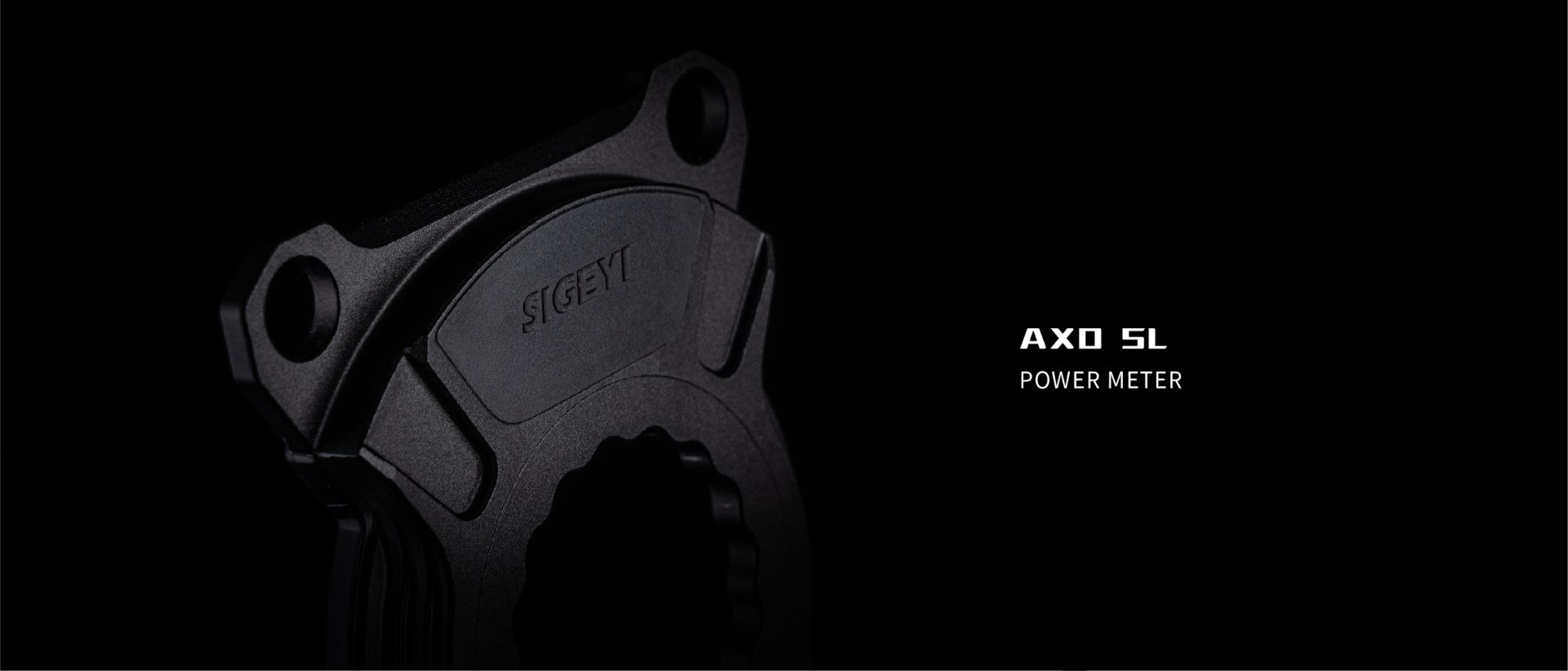
Our first-ride test of the SIGEYI AXO SL spider reproduced a sprint-cadence-sensor failure that renders the power data unusable under hard acceleration: the cadence sensor drops to zero under >1000W load, and the power calculation follows it to garbage. Same failure mode that plagued early Garmin Rally 200 / Vector 3 pedal PMs. 79g, $376 USD. Skip.
Elilee EK01 Spider Power Meter: 1kW+ Sprint Collapse, No Vendor Fix
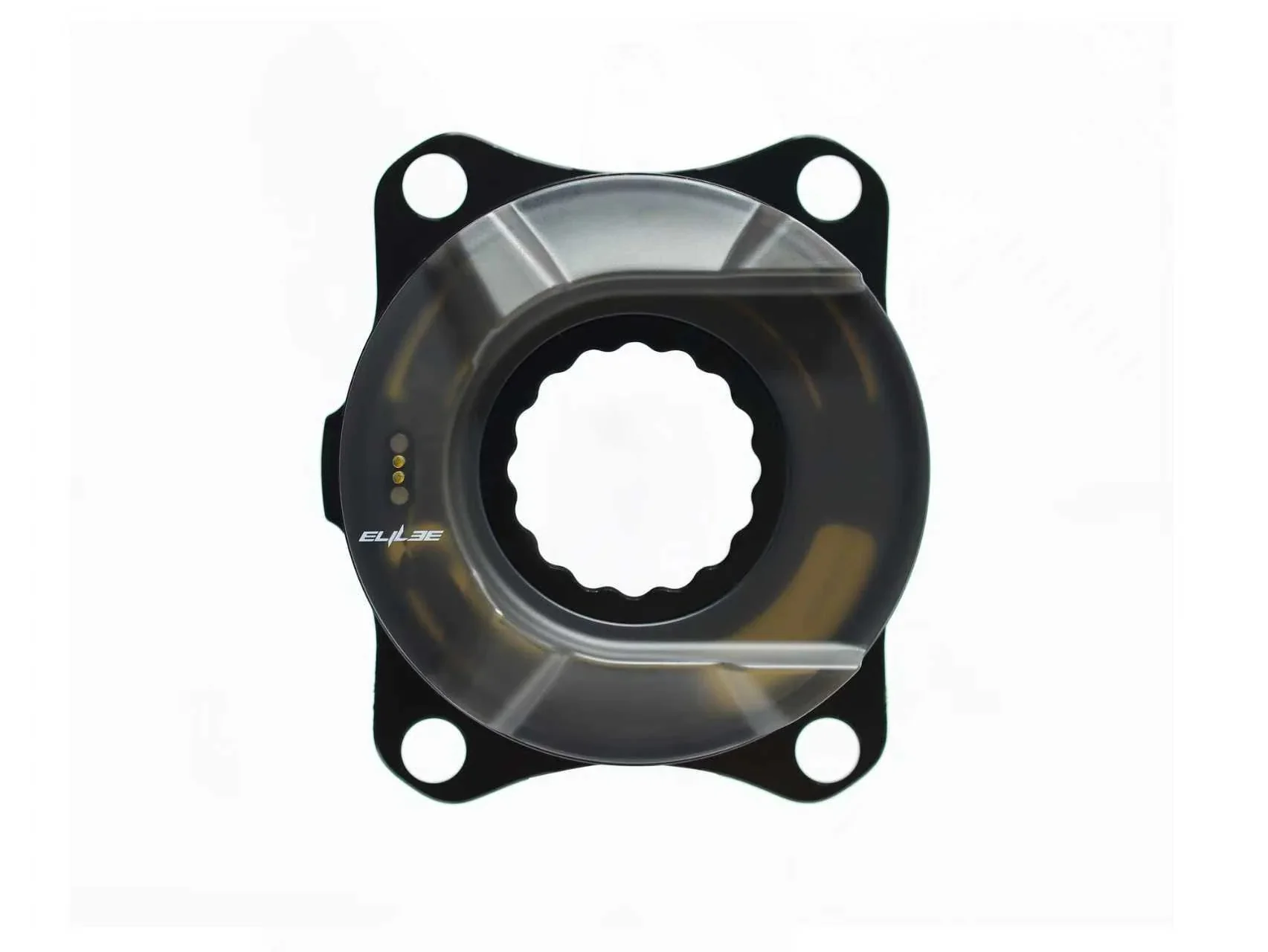
Our two-unit cross-test of the Elilee EK01 spider — aluminum first, then the $1200 AUD carbon as a control — reproduced the same catastrophic failure on both: 4-5 second power/cadence dropout under sprint, residual-torque effect requiring manual re-zero after every hard effort. We paused testing and sent data to the vendor; no fix committed. Skip.
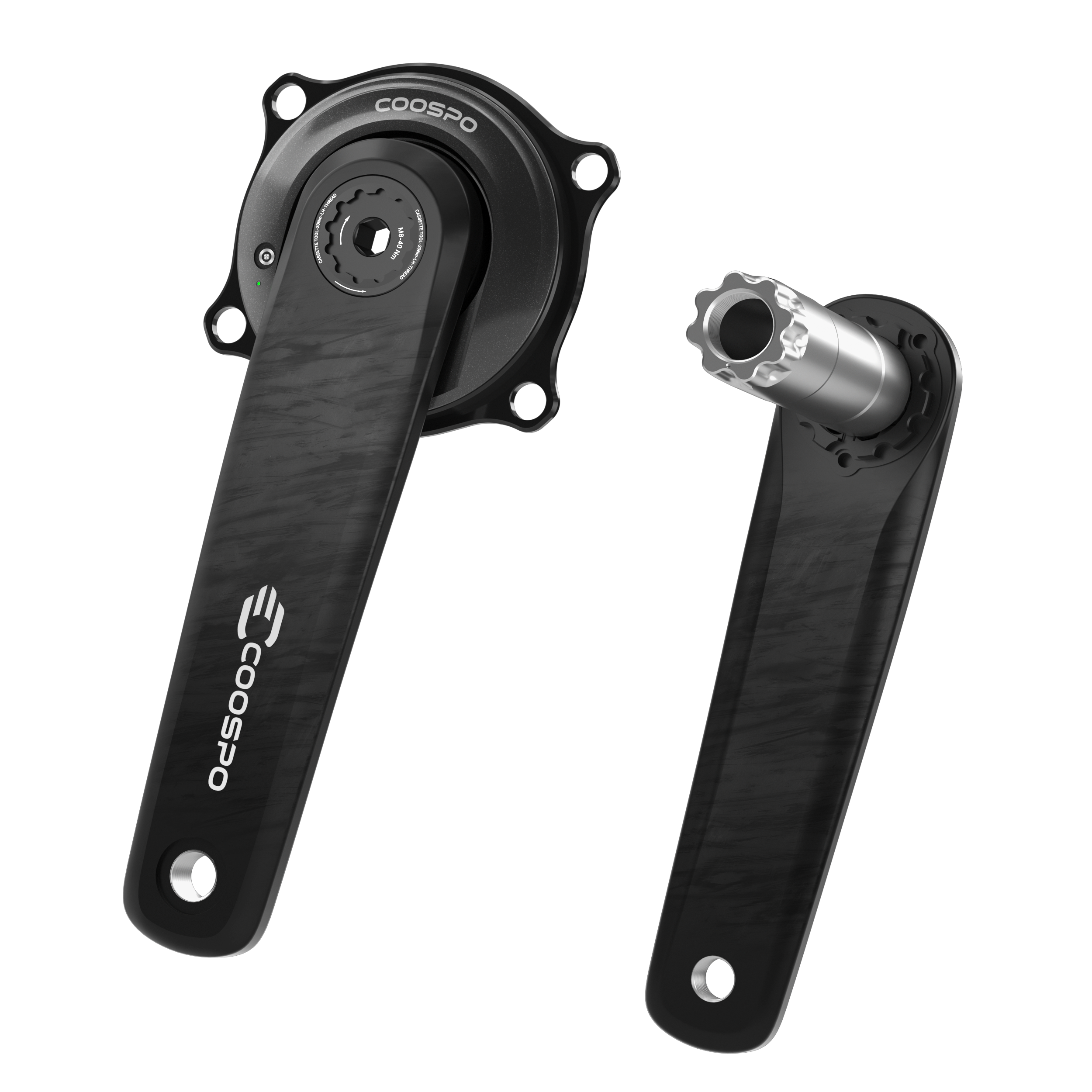
Coospo S10 Spider Power Meter: Sub-$90, Same Bug as PP5, Plus 1s Delay
Our cross-test of the Coospo S10 spider against an Assioma Pro RS and a Garmin Rally RS200 reproduced the same hardware-level residual-torque defect that got the ThinkRider PP5 a skip recommendation — plus a 1-second data-transmission delay. The S10 and PP5 share firmware 1.68 and the same Easton Cinch crank interface. At $88, the cheapest spider PM has the least trustworthy data.
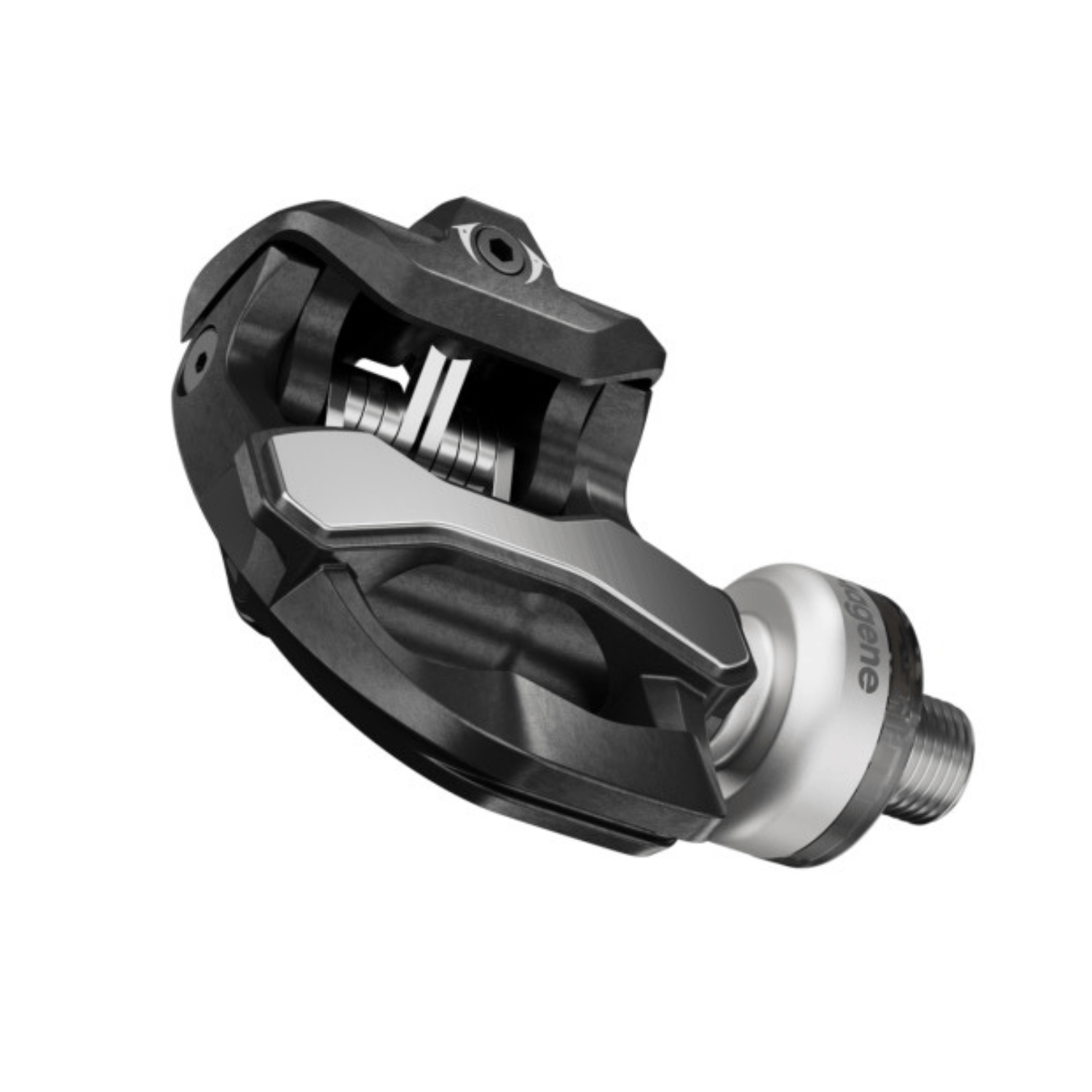
Magene P715 SPD-SL: $499 Dual-Sided, With a Phase-Angle Bug
Our two-month test of the Magene P715 SPD-SL found dual-sided power within 2-3W of a Power2Max NGeco reference across every dataset, with 120h battery, IPX7 sealing, 322g measured weight per pair. The catch: a vendor-confirmed pedal-phase bug that locks start angle at 0° (fix promised by end of April 2026). At $499.
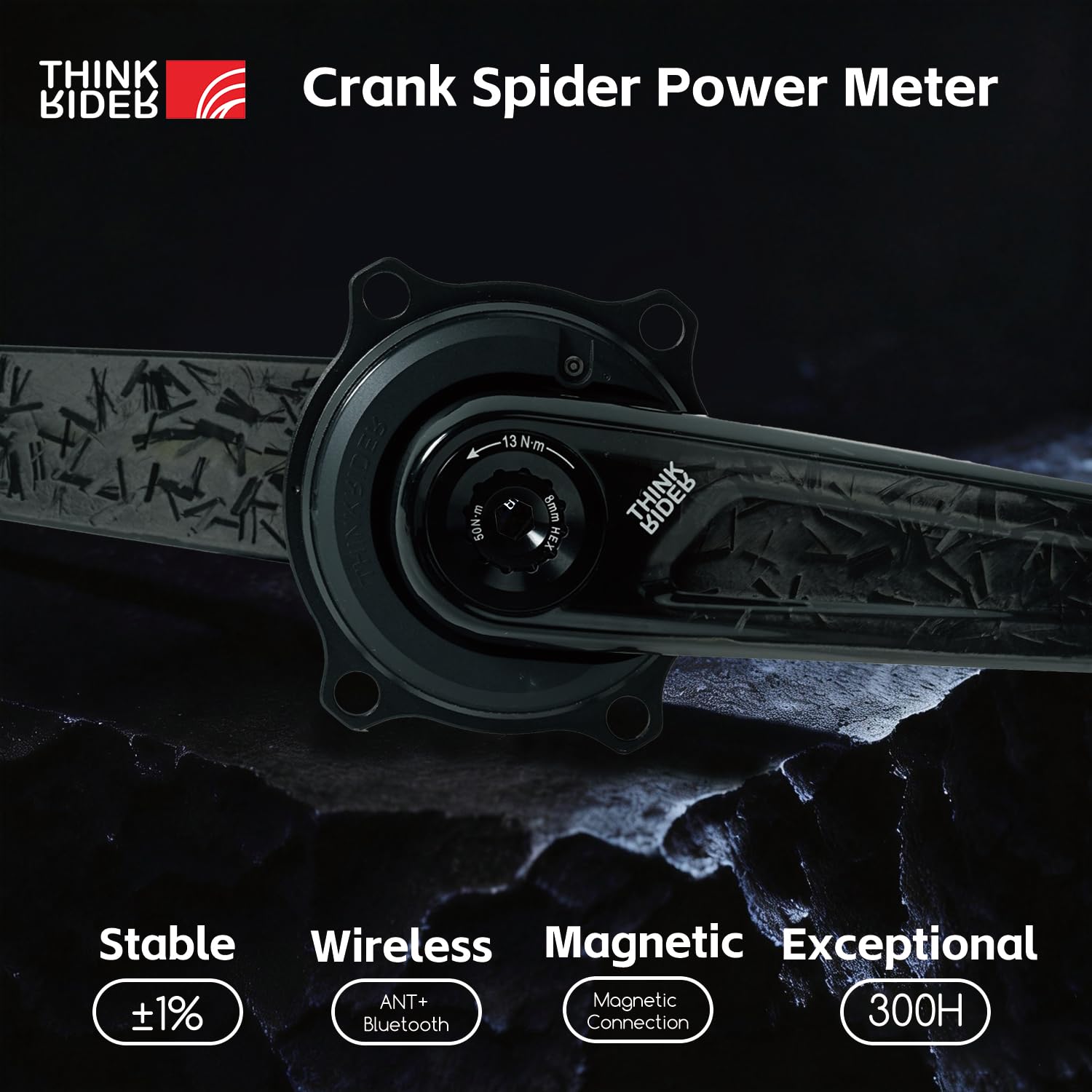
ThinkRider PP5 Spider Power Meter: Skip — Sprint-Collapse Defect
Our two-round test of the ThinkRider PP5 spider found it can drift 18W mid-ride, lose sprint peaks to a cadence dropout, and shift zero offset on every gear change — a power meter that passes the spec sheet on paper and fails the data-integrity check in practice. The PP5 shares firmware 1.68 with the Coospo S10, the same 1.72 update bug, and the same Easton Cinch crank interface. Skip.
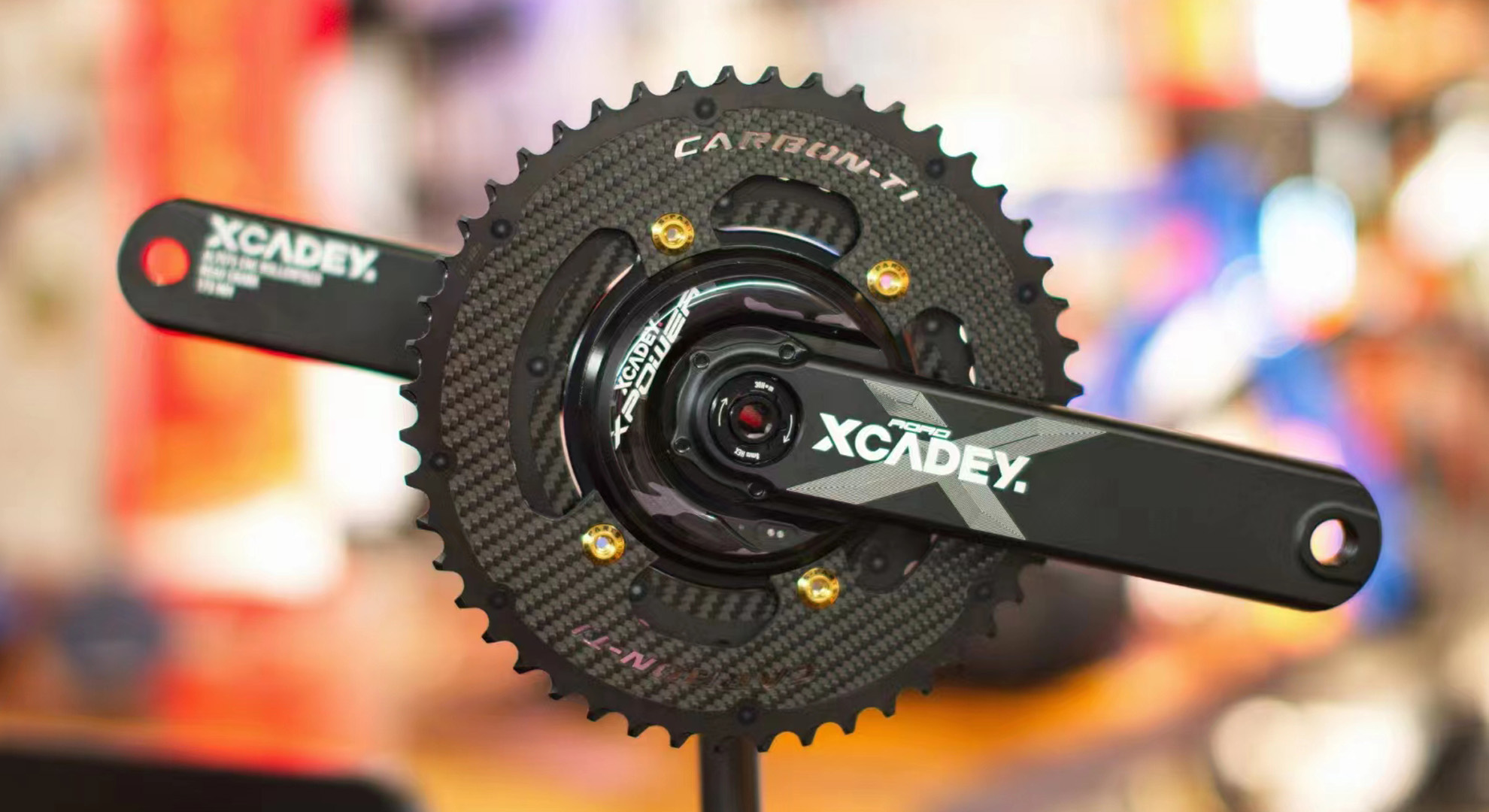
XCadey X-Power S GEN 2: 2022 Spider with 2025-Era Data Issues
Our two-round test of the second-generation XCadey X-Power S GEN 2 spider found it can drift 18W mid-ride, lose sprint peaks to a cadence dropout, and shift zero offset on every gear change — a power meter that passes the spec sheet on paper and fails the data-integrity check in practice.
Verify with JoyAnalyze
Upload your power-meter data to JoyAnalyze and stack Magene P515 Spider Power Meter: Mid-Range Price, Pro-Tier Data against other meters — DTW-aligned power curves, RMS error, drift, and Bland-Altman stats.
Open multi-file compare in JoyAnalyzeSee how this fits you
The Magene P515 Spider Power Meter: Mid-Range Price, Pro-Tier Data is one option. Run the JoyFit assessment to see whether it actually matches your body and riding style — or compare it side-by-side with the other Power Metersin our database.
Community
Discuss this review · Pro members can rateComments
(0)Sign in above to leave a comment.
Loading comments…
Pro Ratings
PROLoading…Sign in above to rate this product on the 8-axis $APPEALS framework.