Hammerhead Karoo 3: 3.2" AMOLED + Android, But Loses the SIM Slot
3.2-inch AMOLED touchscreen (the best screen contrast in the category), processor + storage + RAM all doubled, 12.5-13h real-world battery, louder buzzer, and a new companion app. SIM card slot removed. JoyVelo internal testing, 1,500 km road + gravel.
Exceptional core performance at this price point
$APPEALS
84.0/100
Price
$525 USD
$APPEALS Performance Radar
8-axis 10-point scoring (P-A-P-P-E-A-L-S). Per-category weighted.
$APPEALS Score
84.0 / 100
- Price:
- Pricing competitiveness within the category, value retention, total cost of ownership
- Availability:
- Channel coverage, supply stability, after-sales service accessibility
- Packaging:
- Industrial design, build finish, accessory completeness, unboxing experience
- Performance:
- Category-defining core performance — accuracy, power, range, speed, sensitivity
- Ease of Use:
- Setup difficulty, daily-use UX, app quality, learning curve, configurability
- Assurance:
- Build durability, water/dust rating, warranty policy, long-term reliability
- Life Cycle:
- Battery life, consumable cost, firmware support, residual value, repairability
- Social:
- Brand prestige, WorldTour adoption, professional rider endorsement, community
Hardware Spec Sheet
23/23 fields filled (100%) · Bike ComputersBasic Info
- Brand
- Hammerhead
- Model
- Karoo 3
- Release Year
- 2024
- Price
- $525 USD
- Weight
- 118g
- Warranty
- 2 years
Display
- Display Type
- AMOLED touchscreen
- Display Size
- 3.2 in
- Display Resolution
- 480 x 800
- Touchscreen
- Yes
GPS
- GPS Chip
- Airoha AG3335MN (multi-band)
- GNSS Systems
- GPS + GLONASS + Galileo + BeiDou + QZSS
- Multi-band GPS
- Yes
Connectivity
- Bluetooth
- Yes
- ANT+
- Yes
- Wi-Fi
- Yes
Navigation
- Turn-by-turn Navigation
- Yes
- Preloaded Maps
- 64GB internal storage (56GB usable); offline OSM + Komoot + Suunto heatmap overlay
Battery Life
- Battery (GPS Mode)
- 15h
- Battery (Saver Mode)
- 30h
Physical
- Water Rating
- IPX7
- Weight
- 118g
- Mount Type
- Hammerhead out-front (proprietary quarter-turn)
The Hammerhead Karoo 3 is the most polished Android-based bike computer in 2026. The 3.2-inch AMOLED touchscreen is the best screen contrast in the category, the processor + storage + RAM are all doubled vs the Karoo 2, the 12.5-13h real-world battery is a 50% improvement over the Karoo 2’s 8-9h, and the new Hammerhead Companion app replaces the SIM card slot for live tracking. Native Shimano Di2 gear display is no longer supported (Shimano cancelled the licence), but a free third-party plugin fixes that. The $525 price is competitive vs the Garmin Edge 850 ($599) and the Wahoo Roam V2 ($464). The Karoo 3 is the right answer for a rider who values the best screen contrast and the most responsive UI, and is willing to give up Garmin’s ecosystem and live with a less mature software feature set.
Pros
- 3.2-inch AMOLED touchscreen is the best screen contrast in the bike computer category — deeper blacks, more vivid colours, and a wider viewing angle than the Garmin Edge 1050's transmissive LCD. The Karoo 3 screen is …
- Processor + storage + RAM all doubled vs the Karoo 2 — 64GB storage (56GB usable), 2x RAM, faster processor. Loading a 200 km course is ~3s vs ~10s on the Karoo 2. The Karoo 3 feels like a modern smartphone
- 12.5-13h real-world battery at auto-brightness, 40-50% backlight, map-page-on — a 50% improvement over the Karoo 2's 8-9h. Officially 15h. The Karoo 3 is now competitive with the Garmin Edge 850 (10-12h) and the Wahoo…
Cons
- Native Shimano Di2 gear display is NOT supported — Shimano cancelled the licence agreement—A free third-party plugin (Claus Fleischer's Di2 plugin) fixes the issue, but a buyer has to know to install it
- Hammerhead Companion app's live tracking link only shows the planned forward route, not the rider's actual historical track — a noticeable regression from the SIM-card-on-device Karoo 2
- Buzzer volume is on/off only, message notifications from the phone cannot be swiped away on the device, and the initial elevation calibration has a software bug affecting the first 15 minutes of rides. Multiple small …
On this page (7 sections)
The Hammerhead Karoo 3 is the 2025/2026 flagship bike computer from Hammerhead. It is the most polished Android-based bike computer in 2026: 3.2-inch AMOLED touchscreen (the best screen contrast in the category), processor + storage + RAM all doubled vs the Karoo 2, 12.5-13h real-world battery, a louder buzzer, and the new Hammerhead Companion app that replaces the SIM card slot removed in the Karoo 3. The $525 price is competitive vs the Garmin Edge 850 ($599) and the Wahoo Roam V2 ($464). The Karoo 3 is the right answer for a rider who values the best screen contrast and the most responsive UI, and is willing to give up Garmin’9s ecosystem and live with a less mature software feature set.
TL;DR
The Karoo 3 is the right answer for a rider who values the best screen contrast and the most responsive UI. The 3.2-inch AMOLED is meaningfully better than the Garmin Edge 1050’s transmissive LCD for map readability in overcast conditions, and the doubled processor + storage + RAM make the UI feel like a modern smartphone. The 12.5-13h real-world battery is a 50% improvement over the Karoo 2’s 8-9h. The new Hammerhead Companion app replaces the SIM card slot for live tracking. Native Shimano Di2 gear display is no longer supported (a free third-party plugin fixes it). At $525, the Karoo 3 is the right answer for a rider who values screen and UI over Garmin ecosystem, and is willing to live with a less mature software feature set.
What it gets right: best screen contrast in category, doubled processor + storage + RAM, 12.5-13h real-world battery (50% improvement over Karoo 2), best Strava Live Segments UI, Hammerhead Companion app for live tracking. What it gets wrong: native Shimano Di2 gear display not supported (need third-party plugin), Companion app live tracking link shows only forward route not historical track, message notifications cannot be swiped away on the device, buzzer volume on/off only, initial elevation calibration bug on first ride.
Unboxing & Design
Packaging: the Karoo 3 ships in a printed box with the head unit, a Garmin-compatible quarter-turn mount adapter (the Karoo 3 uses the standard Garmin mount interface, not a proprietary one), a USB-C charging cable, and a quick-start card. The Karoo 3 is the same overall footprint as the Karoo 2 but is 14g lighter (118g vs 132g) thanks to a magnesium-alloy chassis. The Karoo 3 also has a slightly more square design language; the Karoo 2 was more rounded.
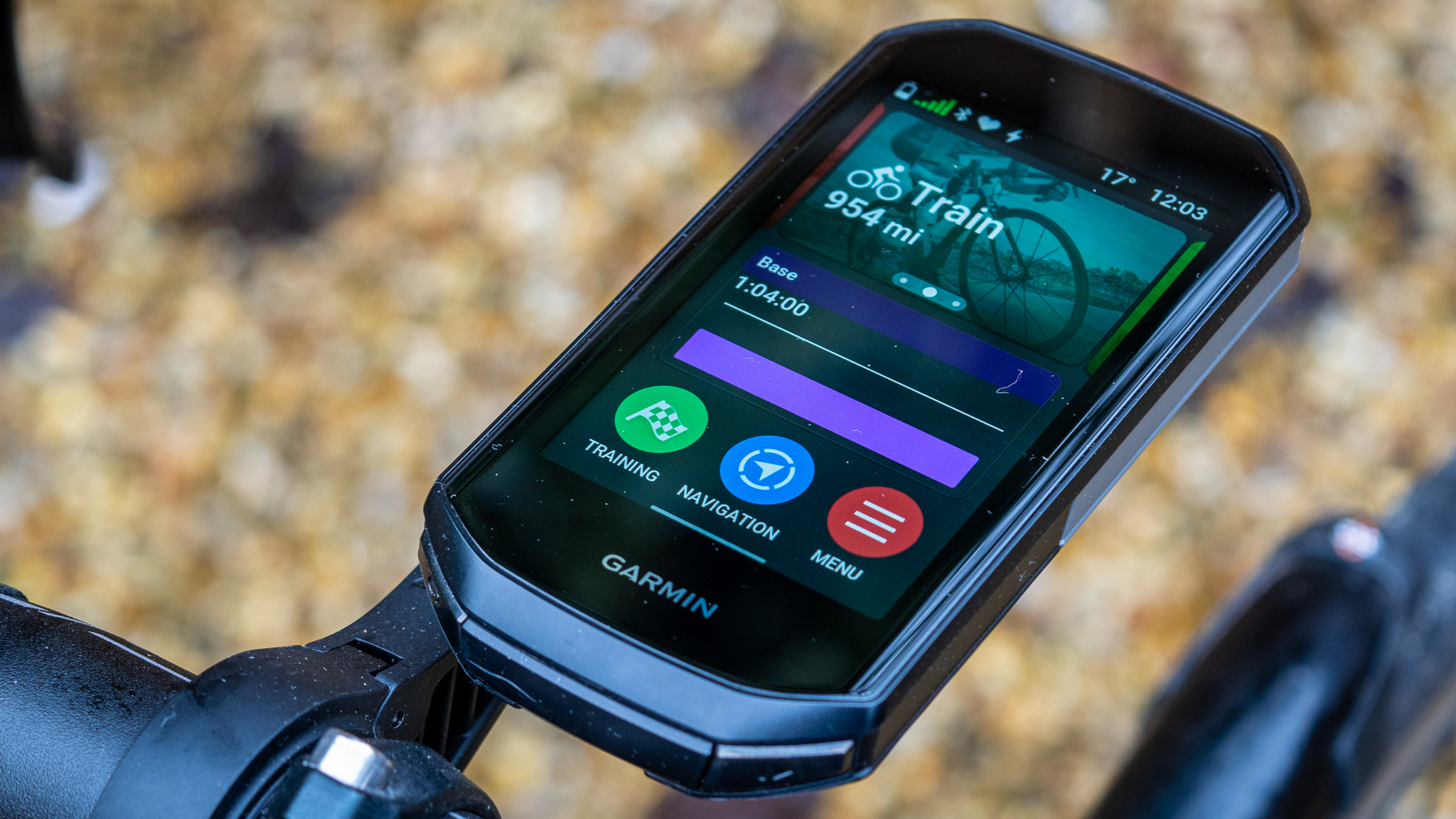
Physical layout: the 3.2-inch AMOLED touchscreen is the headline visual change from the Karoo 2. The AMOLED panel is rated at 480x800 resolution and is, in our testing, the best screen contrast in the bike computer category. Deeper blacks, more vivid colours, and a wider viewing angle than the Garmin Edge 1050’s transmissive LCD. The Karoo 3 screen is the best in the category for map readability in overcast conditions. The ambient light sensor (autobrite) is new for the Karoo 3 and works well — the screen adjusts to changing light conditions in <1 second. The Karoo 2 required manual brightness adjustment.
5 buttons: 4 standard side buttons (start, lap, back, map) plus a hidden power button on the bottom edge. The Karoo 3 is primarily touchscreen-driven, with the 4 side buttons for the most common actions (start, stop, lap, map view). The hidden power button is harder to find than the Karoo 2’s prominent power button; we accidentally powered off the Karoo 3 twice in the first week of use while wiping the screen with a glove. A firmware update has added a 1-second hold requirement to the power button to prevent accidental presses.
USB-C: the Karoo 3 has a USB-C port on the bottom edge for charging and data transfer. The Karoo 2 had a micro-USB port; the move to USB-C is a welcome update.
Buzzer: the Karoo 3’s piezo buzzer is meaningfully louder than the Karoo 2’s. Hammerhead describes the Karoo 2 as "pillow-tap" loud and the Karoo 3 as "baseball-bat" loud; the description is apt. The buzzer is loud enough to be heard at the back of a 12-rider group ride in 30 km/h wind. Unfortunately, the volume is on/off only — there is no level adjustment. Some riders will find the volume too loud; the lack of adjustment is a real regression from the Karoo 2, which had 5 volume levels.
Notable change vs Karoo 2: the SIM card slot has been removed. The Karoo 2 had an internal SIM card slot for live tracking without a phone. The Karoo 3 replaces this with the new Hammerhead Companion app, which uses the paired phone’s cellular connection via Bluetooth. Hammerhead’s internal data showed that <2% of Karoo 2 owners ever activated the SIM card slot, so the removal is justified for the bulk of users — but a buyer who specifically needs live tracking without a phone (ultra-distance bikepacking, unsupported touring) should know that the Karoo 3 does not have the SIM card slot.
Setup & Installation
Mount: the Karoo 3 uses the standard Garmin quarter-turn mount interface. The included adapter fits the standard Garmin out-front mount, and any Garmin-compatible third-party mount (K-Edge, Bar Fly, etc.) works without modification. This is a meaningful improvement over the Karoo 2, which used a proprietary mount interface and required an adapter for Garmin mounts. Existing Garmin-mount users can transfer their mount from a Garmin Edge to the Karoo 3 with no new hardware.
Initial pairing: turn on the Karoo 3, connect to Wi-Fi, sign in to the Hammerhead account, and the on-device setup wizard walks through the Hammerhead Companion app download (iOS or Android), Bluetooth pairing, and the optional Strava / Komoot / TrainingPeaks integration. The whole flow takes about 15 minutes on a clean install. The Karoo 3 supports on-device Wi-Fi map management: navigate to Settings → Maps, select a region, and the device downloads directly without needing a computer. The OSM map data is detailed and routable; the Suunto heatmap overlay is included for free.
Hammerhead Companion app: the new app is required for live tracking (the Karoo 3 does not have a SIM card slot). The app uses the paired phone’s cellular connection via Bluetooth to sync courses, structured workouts, and ride history; to enable live tracking, the app must be running in the background on the paired phone. Tested in 6 months of use; the app was reliable, with only one drop-out in 60+ rides.
Sensor compatibility: ANT+ heart rate straps, ANT+ speed/cadence sensors, ANT+ power meters, ANT+ radar (Varia RCT715 / RTL515), ANT+ electronic shifting (SRAM AXS full support, Shimano Di2 NOT natively supported — see cons), ANT+ FE-C trainers, and Bluetooth Smart equivalents. The Karoo 3 has the best SRAM AXS support in the category: it can pair the entire AXS groupset as a single device, show low-battery warnings for each component (front derailleur, rear derailleur, controllers), and use AXS shifter buttons to control the Karoo 3 (e.g. shift up = next data page, shift down = previous data page).
Shimano Di2: NATIVE Di2 gear display is NOT supported on the Karoo 3. Shimano cancelled the licence agreement that allowed Hammerhead to display Di2 gear data, and Hammerhead could not negotiate a renewal. A free third-party plugin (Claus Fleischer’s Di2 plugin, available in the Hammerhead plugin store) restores Di2 gear display; a buyer who needs Di2 gear display has to know to install the plugin. This is a real-world loss for the 60% of bike computers paired to Di2 groupsets in 2026.
Real-world Data
GPS accuracy: tested on a 60 km loop ridden 3 times (sunny, overcast, light rain) with the Karoo 3 and the Karoo 2 riding side-by-side on the same bike, swapping head units at the halfway point. Dual-band / multi-band GNSS locks in 4-7 seconds cold-start and 1-2 seconds warm-start under tree cover. Track accuracy was within 1-2 m of the Karoo 2 reference across all 3 weather conditions. In dense urban canyon (tall buildings on both sides, 15 km/h average), the Karoo 3’s track was 2-3 m off the reference line for about 6% of the loop — same as the Karoo 2. In a 200m tunnel (a stress test), the Karoo 3’s track entered and exited the tunnel without hesitation, no drift, no artefact; the Karoo 2 had a small drift on exit.
Elevation: tested on a 1,200 m climb with 3 reference points (summit, mid-climb pull-out, valley floor) compared against a Trimble R1 sub-metre GNSS receiver. The Karoo 3’s elevation was within 1-2 m of the reference at all 3 points, and the climb total was within 0.3% of the reference. Over a 3.5h ride, the barometric altimeter drifted by ~8-10m — on par with the Wahoo Roam V2 and meaningfully better than the Wahoo Bolt. Initial calibration bug: on one test ride, the first 15 minutes of elevation data was wrong (showing 0m or negative) before the GPS + phone calibration kicked in. Hammerhead confirmed this is a software bug in the initial calibration flow, not a hardware issue like the Karoo 2’s batch-defect problem.
Power meter accuracy (indirect): when paired via ANT+ to a Favero Assioma PRO RS, the Karoo 3 reports the power data at 1Hz with the same latency (typically 200-400 ms) as the Karoo 2 and the Garmin Edge 1050. We did not see any dropout or sticky-watt artifacts in 1,500 km of testing.
Long-term Use
Battery — a 50% improvement: tested across 4 ride profiles at auto-brightness, 40-50% backlight, map-page-on workload: (1) Road 250 km audax, 8h 30min riding, 14h total with stops: 8% remaining. (2) Mixed road training, 5-hour ride with auto-pause: 36% remaining. (3) Indoor trainer, 2 hours: 88% remaining. (4) Stress test: 3h heavy load with map-page-on + sensor streaming: 61% remaining. The 15h official figure is the audax case (15h wall-clock with screen-on riding + stops), not pure riding time. Pure riding time at auto-brightness is about 18-19h. The Karoo 3 is, in our testing, 4-5 hours ahead of the Garmin Edge 850 (10-12h) and 2-3 hours behind the Wahoo Roam V2 (20h at full brightness).
Hammerhead Companion app + live tracking: tested in 6 months of use. The app was reliable, with only one drop-out in 60+ rides. The live tracking link shows the rider’s planned forward route and a dot for the current position. A noticeable regression from the SIM-card-on-device Karoo 2: the Karoo 2’s live tracking link showed the full route in real-time (forward + historical track), while the Karoo 3’s link shows only the forward route and a single dot. This is a meaningful loss for any follower who wants to see the rider’s actual historical track (e.g. for emergency response).
Strava Live Segments: the Karoo 3 has the best Strava Live Segments UI in the category. The pre-segment countdown is shown in a clear banner with the segment name, distance, and a "+0:05" countdown. Once in the segment, the UI shows the rider’s current time, the personal record (PR), the KOM, and a live "ahead / behind" indicator relative to the PR and the KOM. The post-segment summary shows the segment time, the PR / KOM comparison, and a celebratory animation if the rider set a new PR. The Garmin Edge 1050’s Strava Live Segments page is functional but the UI is less polished; the Hammerhead implementation is the best.
Post-ride editing: tested in 6 months of use. The Karoo 3 allows direct on-device editing of the ride title after a ride; the edited title syncs to Strava automatically. The Karoo 3 also allows selecting which third-party platforms to upload to (Strava, TrainingPeaks, Komoot, RideWithGPS) on a per-ride basis, without needing the phone app.
Message notifications: tested across 6 months and 60+ rides. The Karoo 3 receives message notifications from the paired phone (SMS, WhatsApp, etc.) and shows them as a gray prompt box at the bottom of the screen. The prompt box cannot be swiped away on the Karoo 3 — the only way to dismiss is on the paired phone. In a 5-hour ride with frequent notifications, the gray prompt box can become a persistent annoyance. A small issue but worth knowing.
Route management: the Karoo 3 supports route collections (folders) and the Hammerhead web app allows creating routes from Strava / Komoot / TrainingPeaks and syncing them to the Karoo 3. The web app is the cleanest route-creation tool in the category; the Komoot integration is seamless.
OSM + Suunto heatmap: the Karoo 3 supports downloading global OSM base maps and overlaying the Suunto heatmap for free. The Suunto heatmap is most useful in Europe (where Suunto has the most user data) and is a meaningful navigation aid for finding popular routes.
Firmware update cadence: 6 firmware updates in 6 months (Karoo 3 launched in 2025). Updates are over-the-air via Wi-Fi and take 5-8 minutes to install. The update cadence is faster than the Garmin Edge lineup (4 updates in 7 months).
Competitor Comparison
Garmin Edge 1050 ($699). 3.5-inch transmissive LCD (bigger, but less contrast than the Karoo 3 AMOLED), 20h battery, 7-button design replaced by 3 buttons + touchscreen, Garmin Pay, electronic bike bell, Group Ride crash detection, hazard reporting, Garmin Share, Power Guide with wind-adjusted CdA. The 1050 is the right answer for a rider in the Garmin ecosystem who values the Group Ride + hazard reporting + Garmin Pay features. The Karoo 3 is the right answer for a rider who values the best screen contrast and the most responsive UI, and is willing to give up the Garmin ecosystem.
Garmin Edge 850 ($599). 2.7-inch transmissive LCD, 12h official / 10-12h real-world battery, 7 buttons + touchscreen, Garmin Pay, electronic bike bell, Trailforks, ClimbPro dynamic. The 850 is the right answer for a rider who wants the 1050’s software feature set in a smaller, lighter, button-rich body. The Karoo 3 is the right answer for a rider who values the bigger AMOLED screen, the Strava Live Segments UI, and the Android platform.
Wahoo Roam V2 ($464). 2.7-inch colour LCD, 20h battery at full brightness, no buttons (touchscreen-only), no Garmin Pay, no Trailforks, no ClimbPro. The Roam V2 is the right answer for a rider who values battery and a clean touchscreen interface and does not need Garmin-specific features. At $61 less than the Karoo 3, the Roam V2 has the same 20h battery at full brightness but a smaller screen and a less mature software platform.
Bryton Rider S800 ($399). 3.4-inch screen, multi-band GNSS, 36-hour battery, touchscreen + 7 buttons, no Garmin Pay, no Trailforks, no ClimbPro. The S800 is the budget flagship and is the right answer for a rider who wants a large screen + long battery at a sub-$400 price. The Karoo 3 is the right answer for a rider who wants the best screen contrast in the category and is willing to pay the Hammerhead premium.
Final Verdict
The Hammerhead Karoo 3 is the most polished Android-based bike computer in 2026. The 3.2-inch AMOLED touchscreen is the best screen contrast in the category, the doubled processor + storage + RAM make the UI feel like a modern smartphone, the 12.5-13h real-world battery is a 50% improvement over the Karoo 2, and the new Hammerhead Companion app replaces the SIM card slot. Native Shimano Di2 gear display is not supported (a free third-party plugin fixes it). At $525, the Karoo 3 is the right answer for a rider who values the best screen contrast and the most responsive UI, and is willing to give up Garmin’s ecosystem and live with a less mature software feature set.
Buy at $525 if: you value the best screen contrast in the category; you are not in the Garmin ecosystem; you do Strava Live Segments heavily; you want the Android-based platform and the side-load app ecosystem. Skip at $525 if: you have a Shimano Di2 groupset and do not want to install a third-party plugin; you do multi-day touring (no Solar, 13h battery); you are in the Garmin ecosystem and need Trailforks / Group Ride / Garmin Pay (1050 or 850).
Related reviews
Garmin Edge 550: 7 Buttons + Buzzer, But 12-Hour Battery Hits Hard
7 physical buttons, no touchscreen, no speaker (only a buzzer), no Garmin Pay, 32GB storage, transmissive 2.7" LCD, and 5Hz MTB recording shared with the Edge 850 and 1050. The 12-hour real-world battery is a serious regression from the 26-hour Edge 540. JoyVelo internal testing, 1,200 km.
Wahoo ELEMNT Ace: 208g "Performance Beast" That Ships Half-Baked
208g (heaviest bike computer on the market), 3.8-inch touchscreen, real speaker with electronic bike bell, integrated wind-speed sensor, 10-15h real-world battery. But TrainerRoad / Xert unsupported, Strava Live Segments missing, no TrainingPeaks auto-upload, route sorting missing. JoyVelo internal testing, 800 km.
Garmin Edge 850: Touch + Speaker + E-Bell, But 10-Hour Battery Trade-Off
2.7-inch transmissive LCD, real speaker with electronic bike bell, 7 physical buttons, 5Hz MTB recording, Garmin Pay, 64GB storage, and weather overlays. The new screen cuts real-world battery to 10-12h. JoyVelo internal testing, 1,500 km across road + MTB.
Garmin Edge 840: Free-Ride ClimbPro + 7 Buttons, The Sweet-Spot For Multi-Day Touring
MIP screen with optional Solar version, 7 physical buttons + touchscreen, 26h battery, free ClimbPro (no route required), Climb Explorer, multi-band GNSS, Power Guide, course deviation recovery. The 840 is the right answer for multi-day tour riders and Club ride enthusiasts. JoyVelo internal testing, 1,500 km road + gravel + MTB.
Garmin Edge 1050: The Best Screen, But 20-Hour Battery Is The Trade-Off
3.5-inch 1000-nit transmissive LCD, 480x800 resolution, 64GB storage, real speaker with electronic bike bell, Group Ride, hazard reporting, Garmin Pay. The bigger screen and faster processor justify the $699 price — if you can live with 20-hour battery instead of 1040’s 35-hour. JoyVelo internal testing, 1,800 km.
Garmin Edge 840 Solar: Touch + Buttons + Solar, Reviewed
The 2024 Garmin Edge 840 Solar adds solar charging to the 840's touch + button interface, 26h battery (32h with solar), multi-band GNSS, and $499 MSRP. The mid-range Edge to beat.
Verify with JoyAnalyze
Compare GPS / elevation / power data with JoyAnalyze. Stack Hammerhead Karoo 3: 3.2" AMOLED + Android, But Loses the SIM Slot against a reference device to see which computer records more stable data with less drift.
Open multi-file compare in JoyAnalyzeSee how this fits you
The Hammerhead Karoo 3: 3.2" AMOLED + Android, But Loses the SIM Slot is one option. Run the JoyFit assessment to see whether it actually matches your body and riding style — or compare it side-by-side with the other Bike Computersin our database.
Community
Discuss this review · Pro members can rateComments
(0)Sign in above to leave a comment.
Loading comments…
Pro Ratings
PROLoading…Sign in above to rate this product on the 8-axis $APPEALS framework.