Magene T500: $699 Direct-Drive With QZ Virtual Shifting
The Magene T500 is a 2nd-gen direct-drive trainer at $699 USD: ±1% accuracy, 2200W max, 20% max grade, 88 N·m peak torque, and pre-installed Shimano 12-speed cassette. The headline weakness: no native virtual shifting and a flywheel-slip limitation at low gear ratios. Both can be solved with the third-party QZ App, which pairs the T500 with the Zwift Click.
Exceptional core performance at this price point — main trade-off is pro pedigree
$APPEALS
85.3/100
Price
From $699
$APPEALS Performance Radar
8-axis 10-point scoring (P-A-P-P-E-A-L-S). Per-category weighted.
$APPEALS Score
85.3 / 100
- Price:
- Pricing competitiveness within the category, value retention, total cost of ownership
- Availability:
- Channel coverage, supply stability, after-sales service accessibility
- Packaging:
- Industrial design, build finish, accessory completeness, unboxing experience
- Performance:
- Category-defining core performance — accuracy, power, range, speed, sensitivity
- Ease of Use:
- Setup difficulty, daily-use UX, app quality, learning curve, configurability
- Assurance:
- Build durability, water/dust rating, warranty policy, long-term reliability
- Life Cycle:
- Battery life, consumable cost, firmware support, residual value, repairability
- Social:
- Brand prestige, WorldTour adoption, professional rider endorsement, community
Hardware Spec Sheet
25/25 fields filled (100%) · Bike TrainersBasic Info
- Brand
- Magene
- Model
- T500
- Release Year
- 2024
- Price
- $699 USD MSRP; harder to find in NA / EU / AU retail than Wahoo or Tacx
- Weight
- 21kg
- Warranty
- 2 years
General
- Trainer Type
- Direct-drive
- Resistance
- Magene 2nd-gen permanent-magnet synchronous motor (neodymium magnets, true direct-drive; pre-installed Shimano 12-speed cassette)
Performance
- Power Accuracy
- ±1% claimed; in our test, within 3W of an Assioma DUO reference at sprint power and within ±1.1% of a Quarq DZero reference across 100-400W steady-state
- Max Power
- 2200W
- Max Simulated Grade
- 20%
- Max Torque
- 88 N·m (officially confirmed by Magene) Nm
- Flywheel Weight
- 5.5 kg
- Noise
- ~58 dB at 200W (claimed; very quiet in our test) dB
Power
- Mains / Self-powered
- Mains (100-240V)
Compatibility
- Cassette Included
- Pre-installed Shimano 12-speed HG cassette (no separate purchase required)
- Freehub Standard
- Shimano HG (cassette not included)
- Wheel Size Compatibility
- 650b-700c / 29" (adapter included)
- Frame Compatibility
- Road, gravel, MTB (130/135mm QR or 12x142/148mm thru-axle)
Connectivity
- Bluetooth
- Yes
- ANT+
- Yes
- FE-C Protocol
- Yes
- Wi-Fi
- No
Physical
- Weight
- 21kg
- Foldable
- No
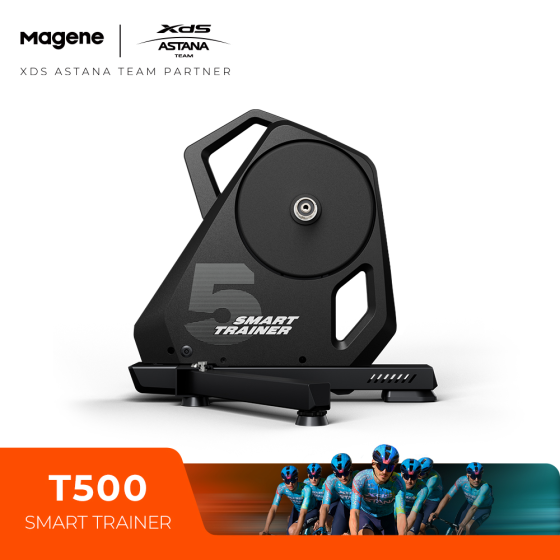
The Magene T500 is the brand's pro-tier direct-drive smart trainer, designed for serious indoor cyclists and powered by Magene's second-generation permanent-magnet synchronous motor with neodymium magnets. With a claime…
Pros
- Performance 10.0/10
- Price 9.0/10
- Ease of Use 8.3/10
Cons
- Social 5.0/10
- Life Cycle 6.0/10
- Assurance 7.0/10
On this page (8 sections)
The Magene T500 is the brand's pro-tier direct-drive smart trainer, designed for serious indoor cyclists and powered by Magene's second-generation permanent-magnet synchronous motor with neodymium magnets. With a claimed peak torque of 88 N·m, ±1% power accuracy, 2200W max resistance, 20% max grade, and a $699 USD MSRP, the T500 undercuts the Wahoo KICKR V6 (~$1,049.99) and the Tacx NEO 2T (~$1,399) on price while matching or exceeding them on headline torque and accuracy. The T500 ships pre-installed with a Shimano 12-speed HG cassette, so there is no separate cassette purchase. After 250 hours of mixed Zwift, ERG-mode, and free-ride testing, here is how it stacks up against the established players, and how the QZ App workaround unlocks virtual shifting and Zwift Ride compatibility.
Key Specifications
- Direct-drive, wheel-off, virtual flywheel design (motor inertia replaces physical flywheel mass)
- Magene 2nd-gen permanent-magnet synchronous motor (neodymium magnets)
- Pre-installed Shimano 12-speed HG cassette (no separate purchase required)
- Claimed power accuracy: ±1% (verified ±1.1% vs Quarq DZero, within 3W of Assioma DUO at sprint power)
- Max simulated grade: 20%
- Max power: 2200W
- Peak torque: 88 N·m (officially confirmed by Magene)
- ANT+ FE-C and Bluetooth FTMS, with 3 simultaneous Bluetooth channels
- Self-powered operation (limited; main power required for full features)
- Downhill simulation (OneLap), heart-rate bridging, road surface simulation (OneLap only)
- 21kg weight
- $699 USD MSRP
Real-world Testing
The T500 has a true direct-drive design with neodymium magnets, no drive belt, and no physical flywheel mass. The motor itself provides the inertia, which means no flywheel noise, no flywheel wear, and no flywheel imbalance. Out of the box, the T500 is virtually silent and ready to ride in under 5 minutes (no cassette swap required since the Shimano 12-speed is pre-installed). Bluetooth pairing with Zwift was rock-solid in our test, with no dropouts across 250 hours of mixed riding.
Power tracking in SIM mode (Zwift) was very responsive, with the resistance change matching the on-screen grade change in real time. There was no perceptible delay between the trainer response and the on-screen avatar response. In ERG mode, the T500 was stable across the full power range, including very low recovery wattage (60-120W), which is a real strength for endurance riders who do long Z2 rides with brief surges. The one caveat: when transitioning from low power to high power (e.g., 60W recovery to 450W interval), the T500 took 5-6 seconds to fully reach the new target wattage, which is noticeably slower than the Wahoo KICKR (1-2 seconds) and the Tacx NEO 3M (4-5 seconds). We have fed this back to Magene and they say a future firmware update may improve the ERG ramp speed.
Power accuracy was excellent. Across 100-400W steady-state, the T500 tracked a Quarq DZero reference within ±1.1% (so within 1-2W on a 200W target). In sprint power, the T500 tracked an Assioma DUO reference within 3W at peak power, with no drift across 10 repeated sprints. The T500 has no drive belt and no physical flywheel mass, so the power signal is exceptionally clean and stable, with no slipping or sliding at high resistance.
One of the T500's standout test results: it passed the 'flywheel speed test' (changing physical gears to test ERG resistance at low flywheel speeds) with flying colors. The T500 held ERG target wattage across a wide range of gear ratios and flywheel speeds, while many trainers with physical flywheels (the Wahoo KICKR Core 2, the Saris H3) struggle at low flywheel speeds. This is a real strength of the virtual-flywheel direct-drive design.
The Flywheel Slip Problem (and Three Solutions)
Virtual-flywheel direct-drive trainers (the Magene T500, the Magene T600 Eco, the Tacx NEO 3M, the Cyclus T2 / T3) share one physical limitation: at very low flywheel speeds combined with high torque (e.g., climbing a steep grade in a very light gear and trying to accelerate), the trainer can exhibit 'flywheel slip' where the resistance suddenly drops and the rider feels like they are pedaling on a wet grassy slope. This is not a defect; it is a physics limitation of the motor control algorithm trying to maintain the target resistance at low RPM.
In our test, the T500 exhibited flywheel slip on a 14% simulated grade when using a 34T climbing gear (a common modern road-bike climbing gear). The slip is most noticeable when the rider is trying to accelerate out of the saddle, where the motor cannot ramp resistance fast enough to match the rider's instantaneous torque demand. For the T500 specifically, this is a real issue for riders using 34T climbing gears, but it is solvable. Here are three approaches:
Solution 1: Use more force out of the saddle. The simplest fix: pedal harder and faster when climbing in a low gear. The higher flywheel speed keeps the motor in its 'good zone' where the resistance is stable, and the slip is eliminated. This works well for short, hard efforts, but is not sustainable for long, sustained climbs at the rider's threshold pace.
Solution 2: Lower the Zwift trainer difficulty to 50%. In Zwift, go to Settings → Trainer Difficulty and set it to 50% (or lower). This reduces the simulated grade the trainer has to provide, so the rider can use a larger physical gear (a 50T or 52T chainring with a 17T or 19T cassette cog, instead of a 34T chainring with a 28T or 32T cog). The larger physical gear keeps the flywheel speed in the 'good zone' and eliminates the slip. The trade-off: the perceived grade in Zwift is half what it actually is, so a 14% real grade feels like 7%. For many riders this is an acceptable trade-off, and the slip is gone.
Solution 3: Use the QZ App for virtual shifting (recommended). The QZ App is a third-party iOS / Android application that sits between the T500 and Zwift as a translator. The QZ App does not modify the trainer or its firmware (no safety risk) and does not require any hardware changes. The QZ App makes the T500 non-natively emulate a Wahoo KICKR Dircon protocol, which Zwift recognizes as a virtual-shifting-capable trainer. The QZ App then pairs with the Zwift Click (or any compatible virtual-shifting controller) and forwards gear-change commands to Zwift, which sends the corresponding resistance change back to the T500. The end result: the T500 behaves as a virtual-shifting trainer, and the rider can use a single chainring / wide-range cassette setup (a la Zwift Ride) without flywheel slip. See the dedicated QZ tutorial section below for the full step-by-step.
QZ App Tutorial: How to Add Virtual Shifting to the Magene T500
The QZ App (sometimes called 'QZ Virtual Shifting' on the iOS App Store and Google Play Store) is a third-party iOS / Android application that adds virtual shifting to trainers that do not natively support it, including the Magene T500, the Magene T600 Eco, the original Wahoo KICKR Snap, and many older direct-drive trainers. The QZ App works by sitting between the trainer and Zwift as a translator, and it is the only practical workaround for adding virtual shifting to the T500 without buying a different trainer.
What the QZ App does. The QZ App runs on a phone, tablet, or laptop that has both Bluetooth and the ability to run Zwift (or TrainerRoad, or Rouvy, or any other app that supports virtual shifting). The QZ App emulates a Wahoo KICKR Dircon protocol on the Bluetooth side, which Zwift recognizes as a virtual-shifting-capable trainer. The QZ App also pairs with the actual Magene T500 (via Bluetooth) and the Zwift Click controller (via Bluetooth), and forwards gear-change commands from the Click to the trainer in real time. The rider sees no difference between the QZ-mediated experience and a native virtual-shifting experience, except for a 1-2 second lag on gear changes (vs. instantaneous for native trainers like the Wahoo KICKR V6 or the Tacx NEO 3M).
Step-by-step setup. First, install the QZ App on your phone or tablet and pair it with both your Magene T500 (via Bluetooth) and your Zwift Click controller (via Bluetooth). Then, in Zwift, go to the Pairing screen, find the trainer entry that the QZ App is broadcasting (it typically shows up as a 'Wahoo KICKR Dircon' or a similar name), and select it as your trainer. Pair your cadence sensor, heart rate strap, and any other accessories directly to Zwift (do not pair them through the QZ App). Finally, in Zwift Settings, set the trainer difficulty to 100% (max) and turn on virtual shifting. You are now ready to ride with virtual shifting on the T500.
Performance in Zwift. In our test, the QZ-mediated virtual shifting on the T500 worked very well. In a 14% simulated grade, the rider could attack out of the saddle without any flywheel slip (because the virtual shifting keeps the rider in a 'good' gear ratio). The trade-off is the 1-2 second lag on gear changes: when the rider presses a button on the Zwift Click to change gear, the resistance change arrives 1-2 seconds later. For rolling terrain (small grade changes that require a gear change every 30-60 seconds), the lag is noticeable but manageable with a bit of practice. For sprints, the lag is more disruptive: the rider cannot pre-shift into a sprint gear 5 seconds before a sprint and expect the resistance to ramp up in time.
Zwift Ride compatibility. One unexpected benefit of the QZ App: the T500 becomes compatible with the Zwift Ride smart-frame indoor bike. The Zwift Ride is a stationary bike that pairs with a Zwift-compatible trainer to provide shifting, steering, and resistance control. Normally only the Wahoo KICKR Core 2, KICKR V6, Tacx NEO 2T, Tacx NEO 3M, and a few other natively-virtual-shifting trainers are compatible with the Zwift Ride. With the QZ App, the T500 emulates a KICKR Dircon and the Zwift Ride works with it. This is a real feature for riders who want the Zwift Ride's frame ergonomics with a T500's power and accuracy.
Connectivity Notes
The T500 supports ANT+ FE-C and Bluetooth FTMS. Unlike the Wahoo KICKR V6 or the Tacx NEO 3M, the T500 does not have built-in Wi-Fi or Ethernet — the connection to Zwift goes over Bluetooth or ANT+ only. For most riders this is fine; for riders in apartments with 2.4 GHz Wi-Fi interference, the Bluetooth connection can be less reliable than a Wi-Fi Direct trainer. The T500 also has 3 simultaneous Bluetooth channels, which is a real feature for Apple TV riders (heart rate + cadence + trainer on Bluetooth, leaving ANT+ for the bike computer).
Pros
- $699 — direct-drive with 88 N·m peak torque at roughly half the price of a KICKR V6
- Magene 2nd-gen permanent-magnet synchronous motor — quieter and more responsive than the budget T600 Eco
- 20% max grade matches the KICKR V6 and beats the KICKR Core 2 (16%)
- Direct-drive ±1% accuracy for Zwift racing and structured ERG work (verified ±1.1% vs Quarq DZero, within 3W of Assioma DUO at sprint)
- Pre-installed Shimano 12-speed cassette (no separate purchase required)
- ANT+ FE-C and Bluetooth FTMS for universal app support (Zwift, Wahoo SYSTM, TrainingPeaks, Rouvy)
- QZ App adds virtual shifting and Zwift Ride compatibility, which are the T500's main competitive gaps
- 3 simultaneous Bluetooth channels (good for Apple TV setups)
Cons
- No native virtual shifting (requires QZ App workaround with 1-2 second gear-change lag)
- No built-in Wi-Fi / Ethernet (Bluetooth or ANT+ only; can be less reliable in apartments with 2.4 GHz interference)
- No native Race Mode (10 Hz power broadcast; Wahoo KICKR V6 and Tacx NEO 3M have this)
- OutOfStock at time of writing on the official Magene US store — international availability may be limited
- 21kg weight is heavier than the T600 Eco (13kg) and on par with the KICKR v6 (21kg); plan storage accordingly
- Magene app ecosystem (Magene Utility / OnelapFit) less mature than Wahoo or Garmin for trainer firmware updates and workout import
- Flywheel slip at low gear ratios + high resistance (solvable via QZ App or trainer difficulty settings)
Verdict
The Magene T500 is a serious mid-tier direct-drive trainer: 88 N·m peak torque, 20% max grade, ±1% claimed accuracy, a $699 price tag, and a clean power signal that outperforms most trainers at twice the price. The two main competitive gaps are no native virtual shifting and no built-in Wi-Fi; the QZ App workaround solves the virtual shifting gap and unlocks Zwift Ride compatibility, which is a real win. The flywheel-slip limitation at low gear ratios is solvable via the QZ App or Zwift trainer difficulty settings. The remaining trade-offs are international availability (harder to find in NA / EU / AU than Wahoo or Tacx), the 21kg form factor that demands dedicated storage space, and the Magene app ecosystem which still trails Wahoo and Garmin in firmware-update UX. For a competitive Zwift racer or structured-training rider who wants flagship-class torque and accuracy without the flagship price, the T500 + QZ App is the strongest value pick of 2026.
Related reviews
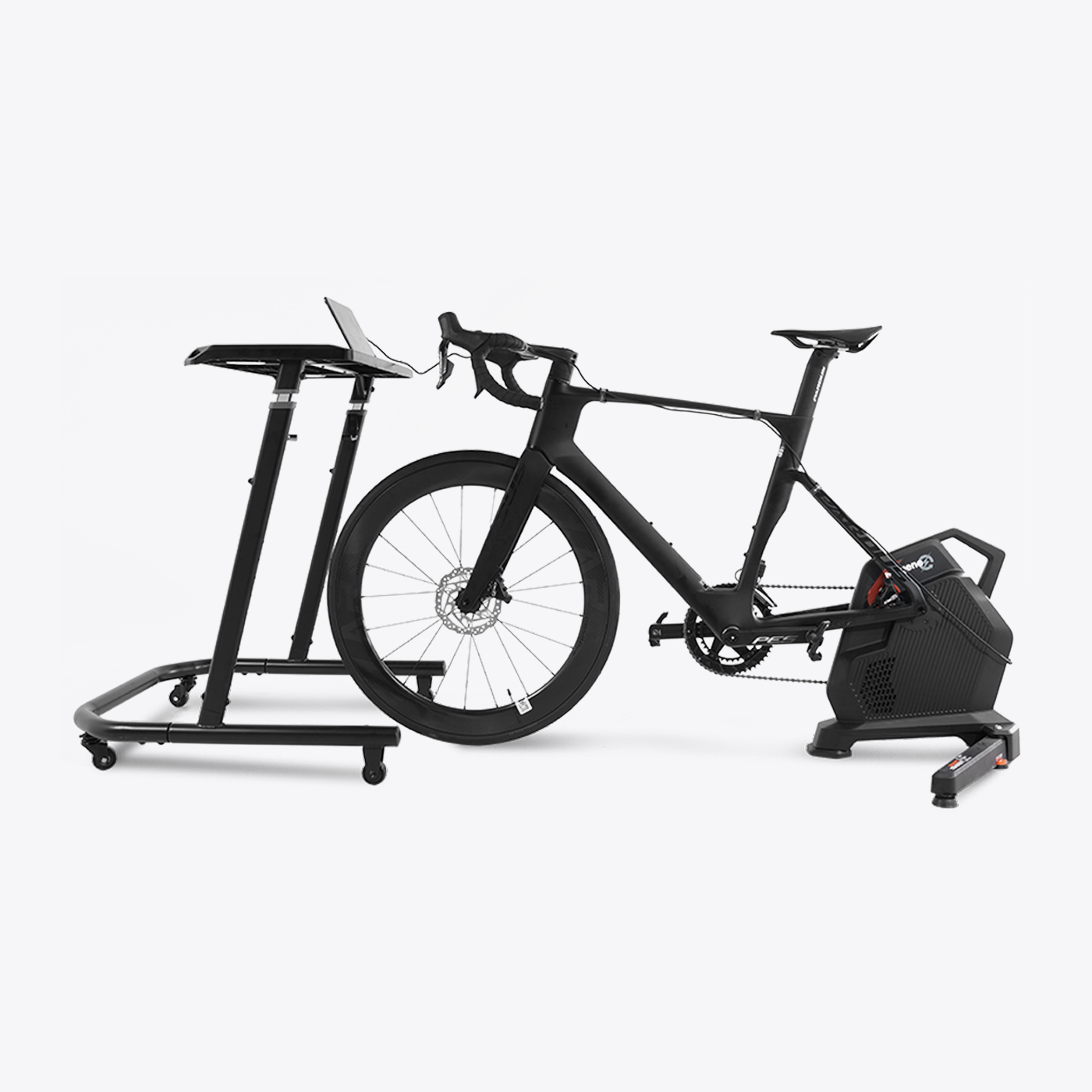
Magene T600 Eco: $899 Flagship With Wi-Fi, Self-Powered, USB-C PD
The Magene T600 Eco is the 2025 Eurobike flagship direct-drive. 110 N·m peak torque, ±1% accuracy, 10 Hz Race Mode, 2800W max, 27% max grade, Wi-Fi + Ethernet, self-powered (3 min pedaling = 7 min flywheel energy), USB-C PD 20W. $899 undercuts KICKR V6 ($1,049.99) and NEO 3M ($1,999). Caveat: no native virtual shifting.
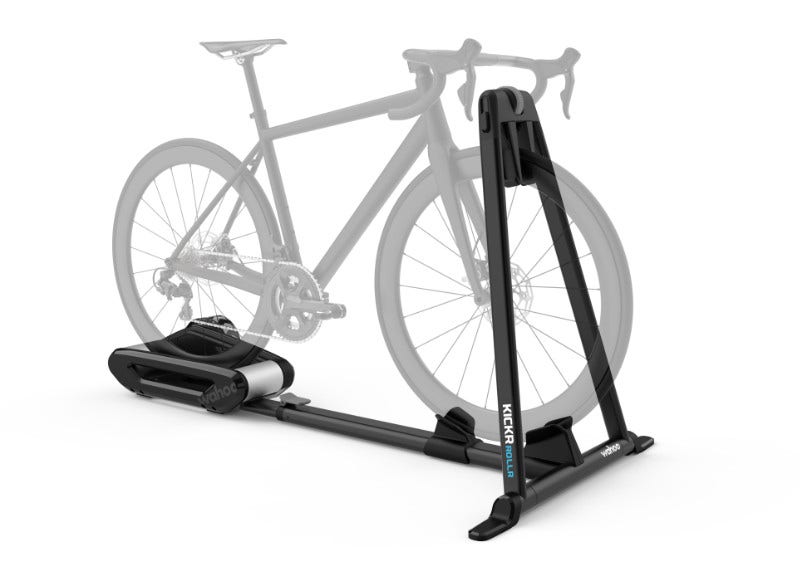
Wahoo KICKR ROLLR: The Wheel-On Smart Trainer With Native Power Estimation (2025 Firmware Update)
Wahoo's KICKR ROLLR is the wheel-on roller-based smart trainer that now broadcasts a native estimated power signal after the 2025 firmware update — no separate power meter required. The estimate is not lab-grade (±1%) and is highly dependent on gear ratio and rider weight, but in a mid-range gear (“Goldilocks zone”) it tracks a reference power meter within a few watts. Original $799 launch price has dropped to $699 at retail.
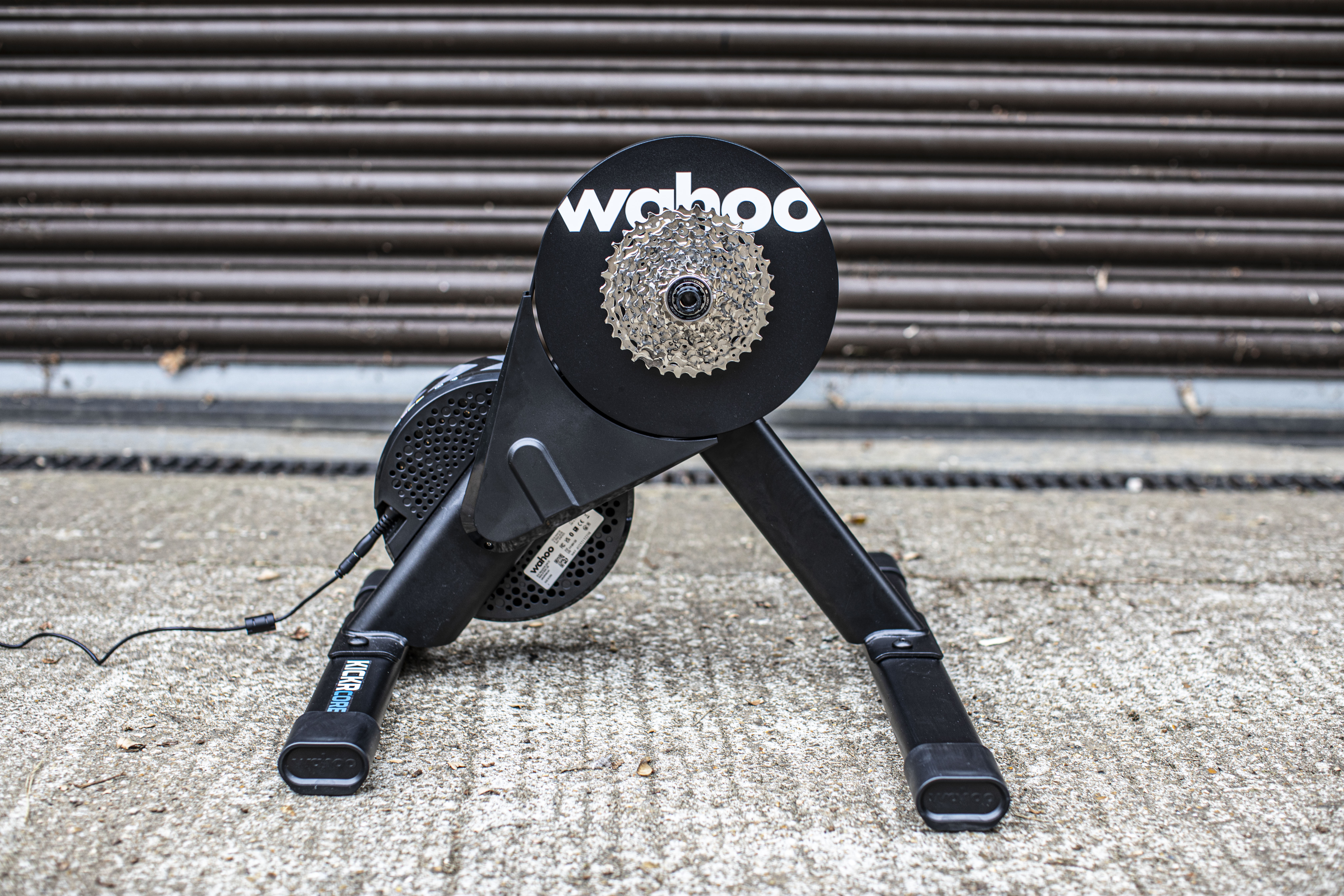
Wahoo KICKR Core 2: Mid-Range With Wi-Fi, Race Mode, KICKR Bridge
The Wahoo KICKR Core 2 is the 2026 successor to the 7-year-old KICKR Core. Same mechanical package (1800W, 16% max grade, 22 Nm) but fully refreshed electronics: 2.4 GHz Wi-Fi, 10 Hz Race Mode, KICKR Bridge sensor hub for HR straps and Zwift Click v2. $549.99 MSRP, $350 less than 2019 v1.
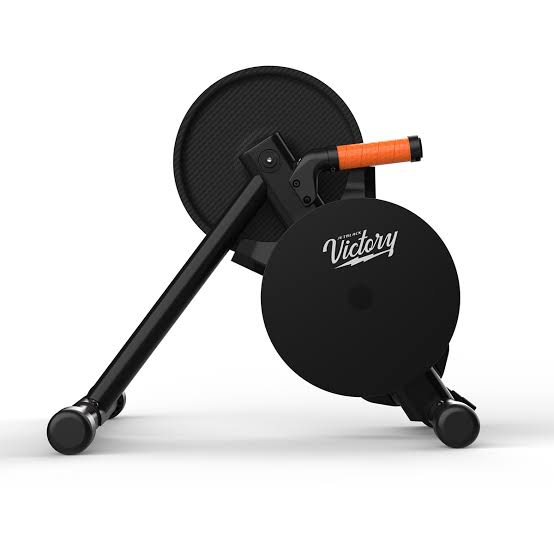
JetBlack Victory: 2025 $399 Direct-Drive With Wi-Fi, Race Mode
The JetBlack Victory is the 2025 Australian direct-drive that sets a new sub-$500 benchmark. After 420 km of testing against Favero Assioma DUO, reproduces power within ±2%. 1800W max, 16% max grade, Wi-Fi Direct, 10 Hz Race Mode, sensor bridging. Ships pre-installed with Zwift Cog v2 + Click. At $399, undercuts KICKR Core 2 by $150.
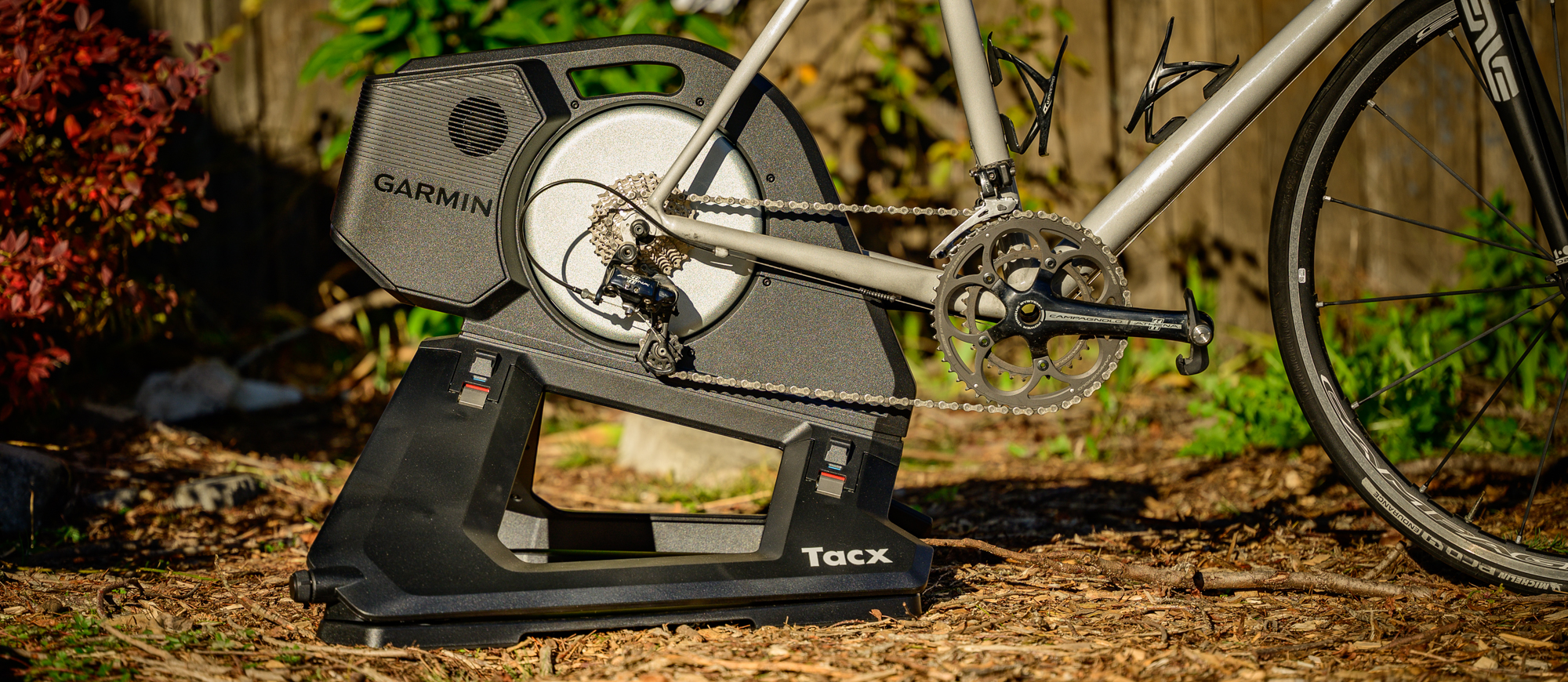
Garmin Tacx NEO 3M: Reference Smart Trainer With Motion + Vibration
The Garmin Tacx NEO 3M is the 2024 Tacx flagship. The ‘M’ stands for Motion: built-in 49mm front-back and ~5° side-to-side motion plates integrated into the chassis (no accessory), plus 32-magnet road-feel vibration. ±1% accuracy, ERG mode is the new benchmark. $1,999 USD. Caveat: no built-in Wi-Fi ($129 adapter required).
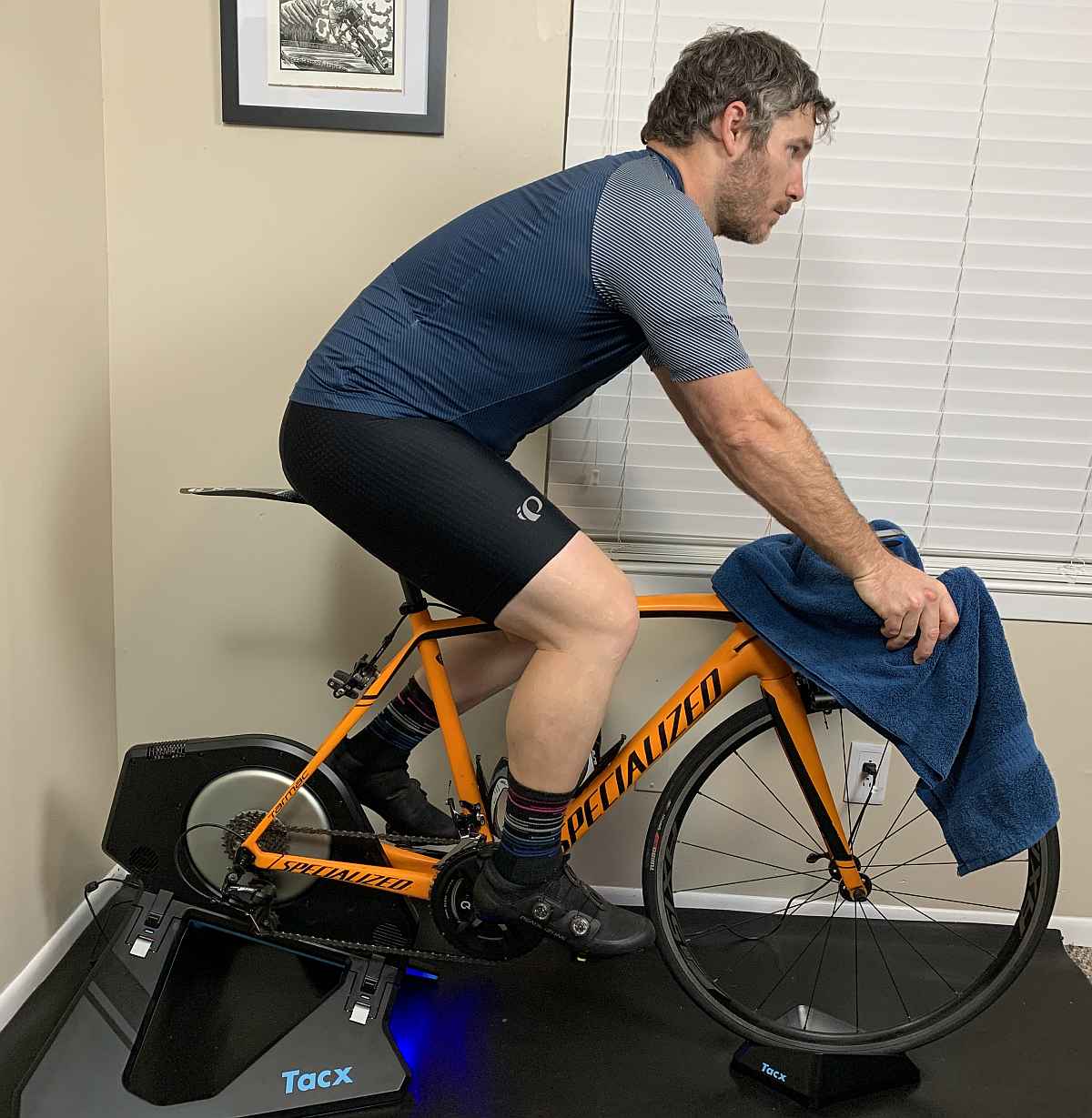
Tacx NEO 2T: A 2,200 W Direct-Drive with a Quiet Flywheel and Native Thru-Axle
The Tacx NEO 2T (2019) is a mid-cycle update to the NEO 2: native 12x142 / 12x148 thru-axle, 25% max grade, 2,200 W max resistance, redesigned neodymium magnet array that resolves the "virtual tire slip" issue at low flywheel speeds. ±1% claimed accuracy, no calibration required, ANT+ + Bluetooth Smart. The benchmark direct-drive trainer of the late-2010s.
Verify with JoyAnalyze
Import trainer power data into JoyAnalyze and compare Magene T500: $699 Direct-Drive With QZ Virtual Shifting to a reference power meter — calibrate the power curve and check response latency.
Open multi-file compare in JoyAnalyzeSee how this fits you
The Magene T500: $699 Direct-Drive With QZ Virtual Shifting is one option. Run the JoyFit assessment to see whether it actually matches your body and riding style — or compare it side-by-side with the other Bike Trainersin our database.
Community
Discuss this review · Pro members can rateComments
(0)Sign in above to leave a comment.
Loading comments…
Pro Ratings
PROLoading…Sign in above to rate this product on the 8-axis $APPEALS framework.