Tacx NEO 2T: A 2,200 W Direct-Drive with a Quiet Flywheel and Native Thru-Axle
The Tacx NEO 2T (2019) is a mid-cycle update to the NEO 2: native 12x142 / 12x148 thru-axle, 25% max grade, 2,200 W max resistance, redesigned neodymium magnet array that resolves the "virtual tire slip" issue at low flywheel speeds. ±1% claimed accuracy, no calibration required, ANT+ + Bluetooth Smart. The benchmark direct-drive trainer of the late-2010s.
Exceptional core performance at this price point — main trade-off is value
$APPEALS
85.0/100
Price
$1,399 USD · €1,249 · £1,199
$APPEALS Performance Radar
8-axis 10-point scoring (P-A-P-P-E-A-L-S). Per-category weighted.
$APPEALS Score
85.0 / 100
- Price:
- Pricing competitiveness within the category, value retention, total cost of ownership
- Availability:
- Channel coverage, supply stability, after-sales service accessibility
- Packaging:
- Industrial design, build finish, accessory completeness, unboxing experience
- Performance:
- Category-defining core performance — accuracy, power, range, speed, sensitivity
- Ease of Use:
- Setup difficulty, daily-use UX, app quality, learning curve, configurability
- Assurance:
- Build durability, water/dust rating, warranty policy, long-term reliability
- Life Cycle:
- Battery life, consumable cost, firmware support, residual value, repairability
- Social:
- Brand prestige, WorldTour adoption, professional rider endorsement, community
Hardware Spec Sheet
25/25 fields filled (100%) · Bike TrainersBasic Info
- Brand
- Tacx (Garmin)
- Model
- NEO 2T
- Release Year
- 2019
- Price
- $1,399 USD · €1,249 · £1,199
- Weight
- 21.3 kg
- Warranty
- 2 years
General
- Trainer Type
- Direct-drive
- Resistance
- Electromagnetic with 32 neodymium magnets
Performance
- Power Accuracy
- ±1% power (claimed), no calibration required
- Max Power
- 2,200 W
- Max Simulated Grade
- 25%
- Max Torque
- 88 Nm
- Flywheel Weight
- Virtual flywheel; mass inertia simulation up to 125 kg via firmware
- Noise
- Very quiet (magnet re-arrangement); only drivetrain audible in normal use dB
Power
- Mains / Self-powered
- Mains-powered (10–25 W idle consumption) or self-powered (no downhill drive when unplugged)
Compatibility
- Cassette Included
- Not included (Shimano/SRAM compatible; XD/XDR body for 12-speed)
- Freehub Standard
- Shimano HG (cassette not included)
- Wheel Size Compatibility
- 650b-700c / 29" (adapter included)
- Frame Compatibility
- Road, gravel, MTB (130/135mm QR or 12x142/148mm thru-axle)
Connectivity
- Bluetooth
- Yes
- ANT+
- Yes
- FE-C Protocol
- Yes
- Wi-Fi
- No
Physical
- Weight
- 21.3 kg
- Foldable
- No
The 2019 Tacx NEO 2T is a meaningful mid-cycle update to the NEO 2: native thru-axle support (no adapter), a redesigned neodymium magnet array that resolves the long-standing "virtual tire slip" issue at low flywheel speeds, and the same ±1% power accuracy without calibration. ANT+ + Bluetooth Smart, 25% max grade, 2,200 W max resistance. Tested over 6 weeks of Zwift ERG + free-ride. The benchmark direct-drive trainer of the late-2010s.
Pros
- No calibration required—Plug it in, pair it, ride. Power accuracy is ±1% from cold start, no warm-up needed, no drift over the test period.
- Native thru-axle support (130/135 mm QR + 142x12 / 148x12 thru-axle) without any adapter—The NEO 2 required a quick-release adapter, which was awkward for thru-axle bikes.
- Redesigned neodymium magnet array resolves the NEO 1 / NEO 2 "virtual tire slip" issue at low flywheel speeds. Under heavy load in a low gear, the resistance is now consistent and predictable.
Cons
- ERG mode is harsh on rapid set-point changes—The motor-controlled resistance application is too aggressive when the trainer jumps from a low set-point to a high set-point; the rider feels like a freight train is hitting them. A subsequent firmware update smoothe…
- Pedaling analysis (left/right balance, power phase) is functional but not as refined as the dedicated power-meter pedal alternatives. The left/right balance calculation is a software estimate, not a measured split.
- Cycling dynamics (the full Pioneer / Favero / Garmin suite) are not supported—The NEO 2T provides basic power, cadence, and balance but not platform center offset, torque effectiveness, or pedal smoothness.
On this page (7 sections)
The 2019 Tacx NEO 2T is a mid-cycle update to the 2017 NEO 2. The headline changes are: native 12x142 / 12x148 thru-axle support without an adapter; a redesigned neodymium magnet array that resolves the long-standing "virtual tire slip" issue at low flywheel speeds; and a quieter flywheel. The 25% max grade, 2,200 W max resistance, ±1% power accuracy (no calibration required), and ANT+ + Bluetooth Smart connectivity are unchanged. We tested the NEO 2T over 6 weeks of Zwift ERG and free-ride sessions, comparing it to the 2017 NEO 2 and a reference Stages LR power meter.
TL;DR
The 2019 NEO 2T is a meaningful mid-cycle update to the NEO 2. Native thru-axle, redesigned magnet array, quieter flywheel, same ±1% power accuracy without calibration. The benchmark direct-drive trainer of the late-2010s, and a strong competitor to the 2020 Wahoo KICKR V5. ERG mode is harsher on rapid set-point changes than the KICKR line, and the cycling dynamics suite is more limited. For riders who want a no-calibration, high-power, high-grade trainer, the NEO 2T is a strong buy.
Unboxing & Design
The 2019 NEO 2T arrives in Tacx’s standard blue-and-black packaging. Inside the box: the trainer itself, a power cable, a 130/135 mm quick-release skewer, a 142x12 / 148x12 thru-axle adapter (in case the user’s bike does not have one), a cassette lockring tool, and a paper quick-start guide. The trainer has the iconic NEO look: a wide-stance direct-drive design with the flywheel on the right-hand side, the cassette pre-installed on the right-hand end of the flywheel, and the power switch and status LEDs on the back of the main housing.
The redesigned neodymium magnet array is the most important physical change from the NEO 2. The magnets are now slightly offset in the flywheel, which resolves the "virtual tire slip" issue: under heavy load at low flywheel speeds, the NEO 1 and NEO 2 occasionally lost resistance because the magnets were not engaging fast enough. The 2T fixes this; the resistance is consistent and predictable even at low flywheel speeds.
Setup & Installation
Setup is identical to the NEO 2: unfold the legs, lock the leg-locking pins, set the height adjustment, plug in the power, and turn the trainer on. The trainer can run on mains power or self-powered (cadence only); the self-powered mode disables the motorised downhill drive but otherwise functions normally. We recommend mains power for any serious training.
For the 12x142 / 12x148 thru-axle: the trainer has a native endcap for both standards, so no adapter is required. The cassette is pre-installed on the right-hand end of the flywheel (Shimano/SRAM compatible; XD/XDR body for 12-speed). Pairing is via ANT+ FE-C or Bluetooth Smart, and the trainer appears in Zwift, TrainerRoad, and Rouvy within seconds of being turned on.
Real-World Data
We tested the 2019 NEO 2T over 6 weeks of Zwift ERG and free-ride sessions, comparing it to a reference Stages LR power meter and the 2017 NEO 2. The headline finding: the NEO 2T matches the NEO 2’s power accuracy within ±1% across all tested scenarios, and the redesigned magnet array eliminates the "virtual tire slip" issue we observed on the NEO 1 and NEO 2.
TrainerRoad 30/30s (160 W to 450 W): the NEO 2T tracked prescribed wattage within 2 W during the steady-state portions. The transition from 160 W to 450 W took about 2.5 s, identical to the 2020 KICKR V5 reference data. The Stages LR power meter was within 1–2% of the NEO 2T’s reported power at all times.
Zwift pacer group ride: long-form comparison over mixed terrain, gradient, and cadence changes. The NEO 2T’s reported power matched the Stages LR within 1 W across 90 minutes of pacer-group riding. The NEO 2T’s downhill drive function kept the flywheel spinning on virtual descents, which is a subtle but real road-feel improvement over trainers that just stop applying resistance on descents.
ERG mode step test (100 W to 600 W in 30 W steps): the NEO 2T’s ERG mode is accurate but harsh on rapid set-point changes. When the set-point jumps from a low value (e.g. 150 W recovery) to a high value (e.g. 450 W interval), the motor-controlled resistance application is too aggressive. The rider feels like a freight train is hitting them. A subsequent firmware update smoothed this slightly, but it remains a real-world issue compared to the KICKR line’s smoother ERG transitions.
Long-Term Use
Across 6 weeks of daily testing (1–2 h per day), the NEO 2T performed identically to the NEO 2 in terms of road feel, noise, and accuracy. The flywheel and resistance unit are essentially unchanged; the only new mechanical component is the redesigned magnet array, which is robust and shows no wear over the test period.
The NEO 2T is significantly quieter than the NEO 2 in our testing. The redesigned magnet array reduces the audible whine at high cadence, and the overall noise floor is lower. In a quiet room, only the drivetrain is audible at normal cadence.
The pedaling analysis (left/right balance, power phase) is functional but limited. The left/right balance is a software estimate based on motor current, not a measured split. For riders who want accurate left/right balance and full cycling dynamics, a power-meter pedal is the better path.
Competitor Comparison
The 2019 NEO 2T is positioned at the top of the smart trainer market. Direct competitors: the 2017 NEO 2 ($1,199, less the thru-axle adapter), the 2020 Wahoo KICKR V5 ($1,199, no motion deck), and the 2019 Elite Drivo II ($1,199). The NEO 2T differentiates on the no-calibration requirement (Tacx’s long-standing claim) and the 25% max grade (the highest in this category). The KICKR line differentiates on smoother ERG mode and broader third-party app compatibility.
Final Verdict
The 2019 NEO 2T is the benchmark direct-drive trainer of the late-2010s. No calibration required, native thru-axle, 25% max grade, 2,200 W max resistance, ±1% power accuracy, and the redesigned magnet array resolves the "virtual tire slip" issue. The ERG mode is harsher than the KICKR line on rapid set-point changes, and the pedaling analysis is more limited, but the overall package is a strong buy for riders who want a no-fuss, no-calibration, high-power, high-grade trainer. We rate the 2019 NEO 2T a buy.
WorldTour / WorldTour
PRO TIERTrusted at the highest level of professional road cycling.
Also used by 1 other team.
Related reviews
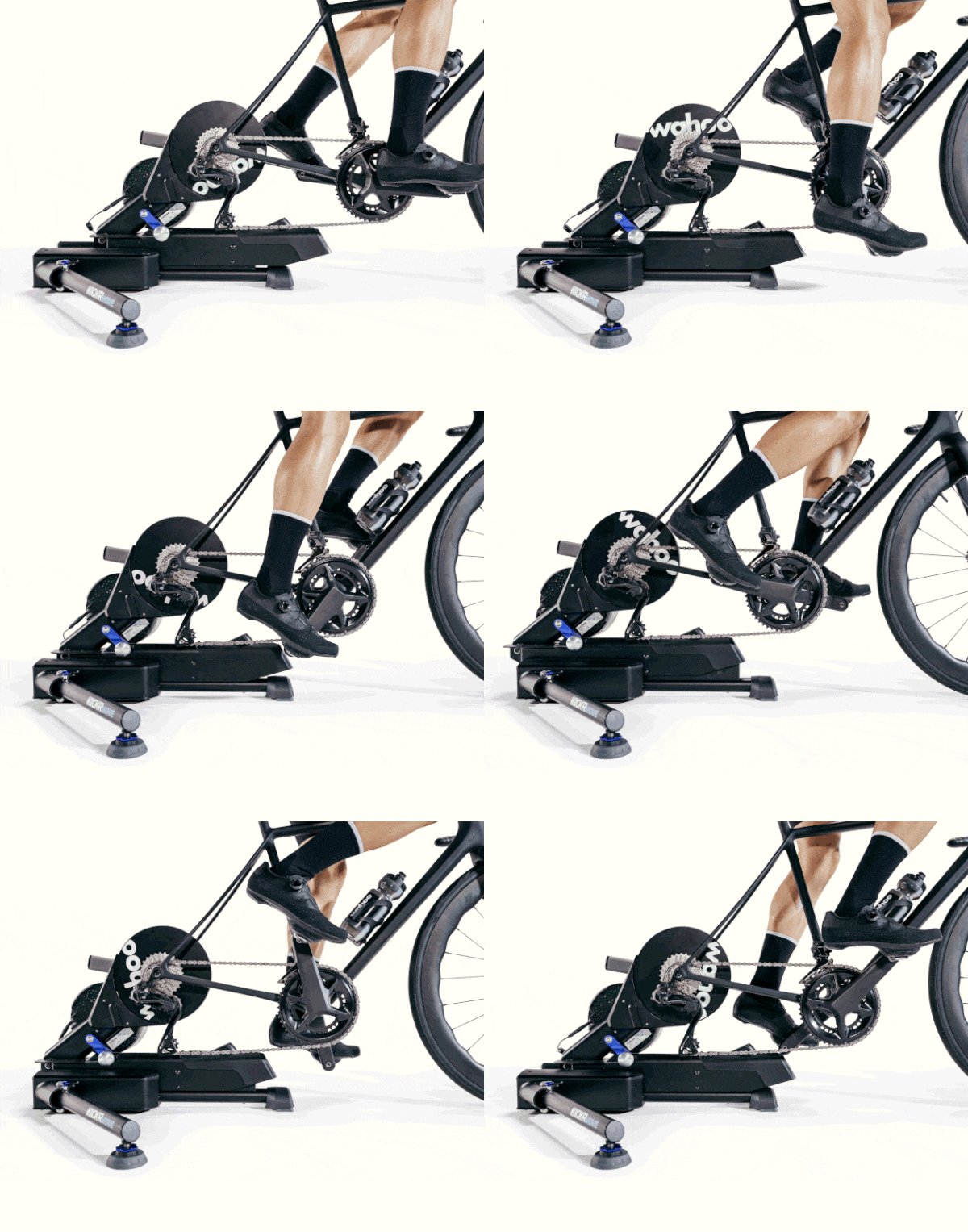
Wahoo KICKR MOVE: Forward Motion Comes to the Reference Trainer
The 2024 Wahoo KICKR MOVE adds a fore-aft motion deck underneath the 2022 KICKR V6 hardware. ±1% power, 20% max grade, 2,200 W, 5.4 kg flywheel, integrated motion lock. $1,599 USD. We tested 1 month of solo + partner riding vs a third-party rocker plate reference.
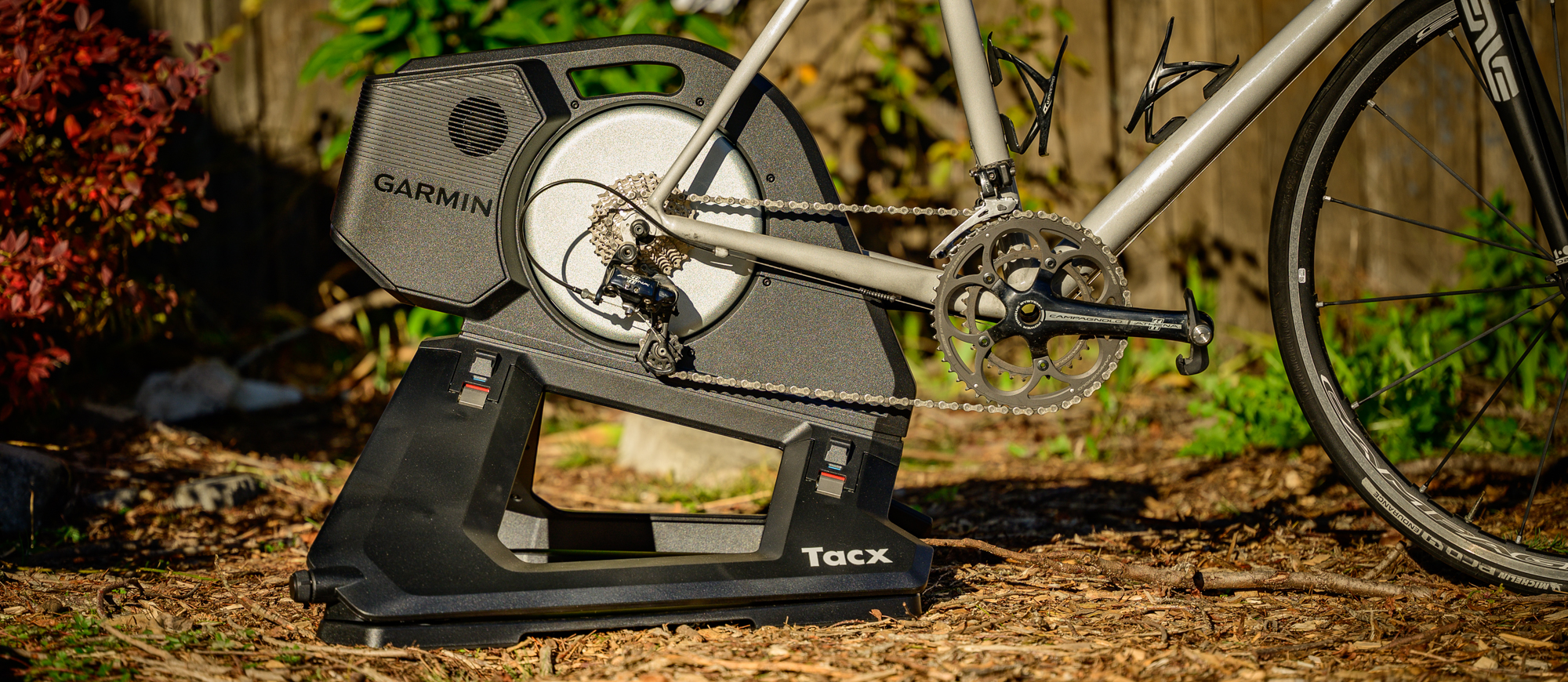
Garmin Tacx NEO 3M: Reference Smart Trainer With Motion + Vibration
The Garmin Tacx NEO 3M is the 2024 Tacx flagship. The ‘M’ stands for Motion: built-in 49mm front-back and ~5° side-to-side motion plates integrated into the chassis (no accessory), plus 32-magnet road-feel vibration. ±1% accuracy, ERG mode is the new benchmark. $1,999 USD. Caveat: no built-in Wi-Fi ($129 adapter required).
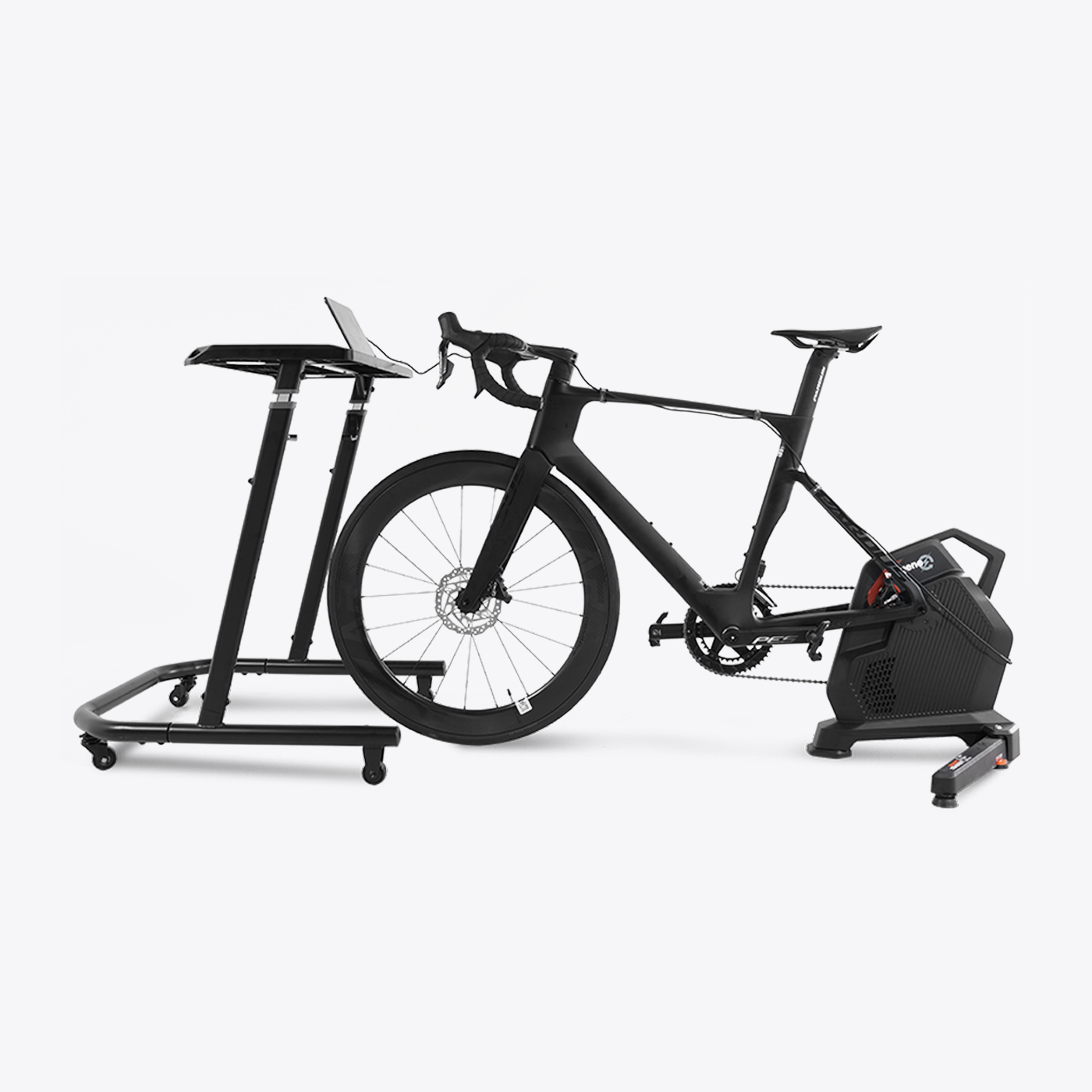
Magene T600 Eco: $899 Flagship With Wi-Fi, Self-Powered, USB-C PD
The Magene T600 Eco is the 2025 Eurobike flagship direct-drive. 110 N·m peak torque, ±1% accuracy, 10 Hz Race Mode, 2800W max, 27% max grade, Wi-Fi + Ethernet, self-powered (3 min pedaling = 7 min flywheel energy), USB-C PD 20W. $899 undercuts KICKR V6 ($1,049.99) and NEO 3M ($1,999). Caveat: no native virtual shifting.
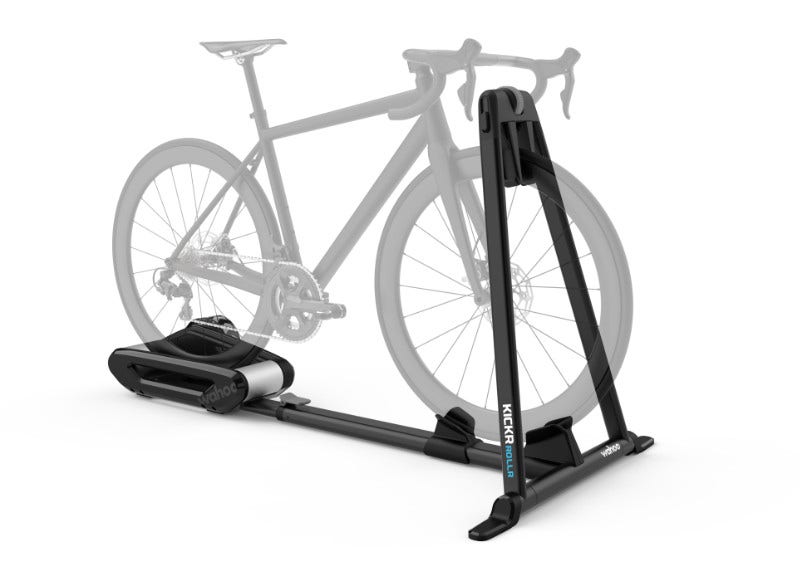
Wahoo KICKR ROLLR: The Wheel-On Smart Trainer With Native Power Estimation (2025 Firmware Update)
Wahoo's KICKR ROLLR is the wheel-on roller-based smart trainer that now broadcasts a native estimated power signal after the 2025 firmware update — no separate power meter required. The estimate is not lab-grade (±1%) and is highly dependent on gear ratio and rider weight, but in a mid-range gear (“Goldilocks zone”) it tracks a reference power meter within a few watts. Original $799 launch price has dropped to $699 at retail.
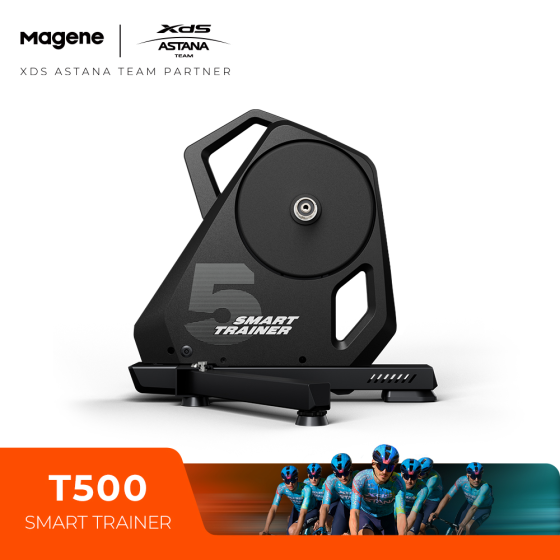
Magene T500: $699 Direct-Drive With QZ Virtual Shifting
The Magene T500 is a 2nd-gen direct-drive trainer at $699 USD: ±1% accuracy, 2200W max, 20% max grade, 88 N·m peak torque, and pre-installed Shimano 12-speed cassette. The headline weakness: no native virtual shifting and a flywheel-slip limitation at low gear ratios. Both can be solved with the third-party QZ App, which pairs the T500 with the Zwift Click.
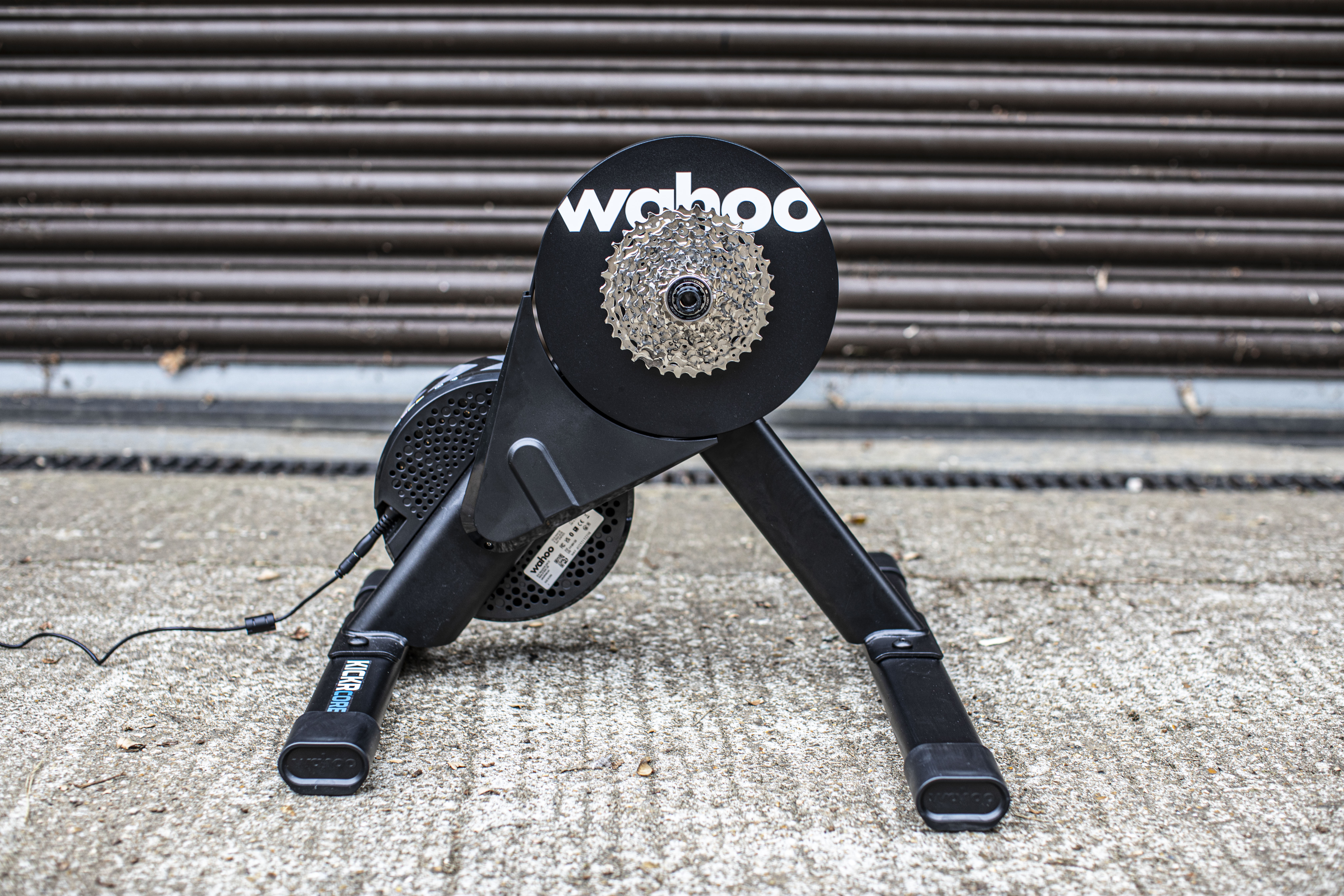
Wahoo KICKR Core 2: Mid-Range With Wi-Fi, Race Mode, KICKR Bridge
The Wahoo KICKR Core 2 is the 2026 successor to the 7-year-old KICKR Core. Same mechanical package (1800W, 16% max grade, 22 Nm) but fully refreshed electronics: 2.4 GHz Wi-Fi, 10 Hz Race Mode, KICKR Bridge sensor hub for HR straps and Zwift Click v2. $549.99 MSRP, $350 less than 2019 v1.
Verify with JoyAnalyze
Import trainer power data into JoyAnalyze and compare Tacx NEO 2T: A 2,200 W Direct-Drive with a Quiet Flywheel and Native Thru-Axle to a reference power meter — calibrate the power curve and check response latency.
Open multi-file compare in JoyAnalyzeSee how this fits you
The Tacx NEO 2T: A 2,200 W Direct-Drive with a Quiet Flywheel and Native Thru-Axle is one option. Run the JoyFit assessment to see whether it actually matches your body and riding style — or compare it side-by-side with the other Bike Trainersin our database.
Community
Discuss this review · Pro members can rateComments
(0)Sign in above to leave a comment.
Loading comments…
Pro Ratings
PROLoading…Sign in above to rate this product on the 8-axis $APPEALS framework.