Garmin Tacx NEO 3M: Reference Smart Trainer With Motion + Vibration
The Garmin Tacx NEO 3M is the 2024 Tacx flagship. The ‘M’ stands for Motion: built-in 49mm front-back and ~5° side-to-side motion plates integrated into the chassis (no accessory), plus 32-magnet road-feel vibration. ±1% accuracy, ERG mode is the new benchmark. $1,999 USD. Caveat: no built-in Wi-Fi ($129 adapter required).
Exceptional core performance at this price point — main trade-off is value
$APPEALS
86.0/100
Price
From $1,999
$APPEALS Performance Radar
8-axis 10-point scoring (P-A-P-P-E-A-L-S). Per-category weighted.
$APPEALS Score
86.0 / 100
- Price:
- Pricing competitiveness within the category, value retention, total cost of ownership
- Availability:
- Channel coverage, supply stability, after-sales service accessibility
- Packaging:
- Industrial design, build finish, accessory completeness, unboxing experience
- Performance:
- Category-defining core performance — accuracy, power, range, speed, sensitivity
- Ease of Use:
- Setup difficulty, daily-use UX, app quality, learning curve, configurability
- Assurance:
- Build durability, water/dust rating, warranty policy, long-term reliability
- Life Cycle:
- Battery life, consumable cost, firmware support, residual value, repairability
- Social:
- Brand prestige, WorldTour adoption, professional rider endorsement, community
Hardware Spec Sheet
25/25 fields filled (100%) · Bike TrainersBasic Info
- Brand
- Garmin
- Model
- Tacx NEO 3M
- Release Year
- 2024
- Price
- $1,999 USD MSRP; $400 more than Wahoo KICKR Move; $129 accessory for Wi-Fi/Ethernet adapter (not bundled)
- Weight
- Approximately 22 kg (claimed; chassis is large and heavy due to internal power supply + thermal system)
- Warranty
- 2 years
General
- Trainer Type
- Direct-drive
- Resistance
- Electromagnetic motor brake, internal power supply
Performance
- Power Accuracy
- ±1% claimed; within 1W of Favero Assioma + Garmin Rally XC reference in our test
- Max Power
- 2200W
- Max Simulated Grade
- 25%
- Max Torque
- 32Nm
- Flywheel Weight
- Virtual flywheel (motor inertia, no physical flywheel)
- Noise
- ~58 dB at 200W (claimed, very quiet; cooling fan only spins up at extreme sustained power, still well below breathing/fan noise) dB
Power
- Mains / Self-powered
- Mains (100-240V) + self-powered descent
Compatibility
- Cassette Included
- Pre-installed 11-speed Shimano HG (cassette included in box); other freehub bodies (XD/XDR, Campagnolo, Micro Spline) sold separately
- Freehub Standard
- Shimano HG (cassette not included)
- Wheel Size Compatibility
- 650b-700c / 29" (adapter included)
- Frame Compatibility
- Road, gravel, MTB (130/135mm QR or 12x142/148mm thru-axle)
Connectivity
- Bluetooth
- Yes
- ANT+
- Yes
- FE-C Protocol
- Yes
- Wi-Fi
- Not built-in; requires $129 Garmin smart network adapter (external, plugs into rear port) for Wi-Fi or Ethernet
Physical
- Weight
- Approximately 22 kg (claimed; chassis is large and heavy due to internal power supply + thermal system)
- Foldable
- No
The Garmin Tacx NEO 3M is the 2024 Tacx flagship. Headline changes: built-in 49mm front-back and ~5° side-to-side motion plates integrated into the chassis (no accessory), internalised power supply, integrated carry handle, 32-magnet road-feel vibration. ±1% accuracy, ERG mode is the new benchmark (4-5s smooth transition, 1-3W overshoot). $1,999 USD.
Pros
- Best-in-class ERG mode: 4-5s smooth transition with 1-3W overshoot (vs 15-70W on competitors), validated across 30x30 intervals and threshold holds.
- Unique road-feel vibration: 32 magnets at millisecond cadence simulate cobblestone, gravel, dirt, and wood bridge textures.
- Self-powered operation + Downhill Drive (when plugged in): trainer runs on kinetic generation, place anywhere without a power cable.
Cons
- No built-in Wi-Fi: the $129 Garmin smart network adapter is required for wireless/Ethernet.
- Front-back motion lock requires dismounting to engage/disengage; the Wahoo KICKR Move can be locked while seated.
- No Race Mode equivalent (10 Hz high-frequency power broadcast); KICKR V6 / Core 2 Race Mode delivers real-time avatar updates in Zwift.
On this page (7 sections)
The Garmin Tacx NEO 3M is the 2024 flagship direct-drive smart trainer from Garmin’s Tacx line, four years after the 2018 NEO 2T. The “M” in the name stands for Motion — the trainer ships with built-in front-back (49 mm / ~2.5 cm each direction) and side-to-side (~5° symmetric) motion plates integrated into the chassis, eliminating the need for the Neo Motion Plates accessory. The headline change from the NEO 2T: a fully internalised power supply (no external brick), an upgraded thermal system for low-speed climb accuracy, an integrated carry handle, a screw-locking thru-axle adapter, and — uniquely in the market — simulated road-feel vibration (cobblestone, gravel, dirt, wood bridge) generated by 32 magnets vibrating at millisecond cadence. Power accuracy is ±1% claimed and matches the Favero Assioma and Garmin Rally XC reference within rounding in our test; ERG mode is the new benchmark (4-5 second smooth transition, 1-3W overshoot). The two real caveats: there is no built-in Wi-Fi (a $129 external adapter is required for wireless/ethernet connection), and the front-back motion lock requires dismounting to engage. At $1,999 USD the NEO 3M is $400 more than the Wahoo KICKR Move and roughly the same as the KICKR V6 + KICKR Move plate; the value argument depends on how much you weight self-power, road-feel vibration, and Tacx’s ERG benchmark.
The NEO 3M chassis is the largest and heaviest in the Tacx line. The “beast” label is earned by two changes from the NEO 2T: the external power brick has been internalised into the rear of the chassis, and a new thermal system (larger heatsink + bigger internal fan) has been added to keep the electromagnetic motor accurate at sustained low-cadence high-torque efforts. The 11-speed Shimano HG cassette is included in the box (12-speed is not available in 2024, which is a small miss at this price point). The thru-axle adapter is now screw-locking, which is a real improvement over the 2T’s design that occasionally dropped the adapter when the trainer was moved. The integrated carry handle on the top of the chassis is a small but welcome addition for moving the 22 kg unit. Long-cage rear derailleurs may brush the chassis slightly at the largest cog — a real caveat for riders with 11-36 or 11-40 cassettes.
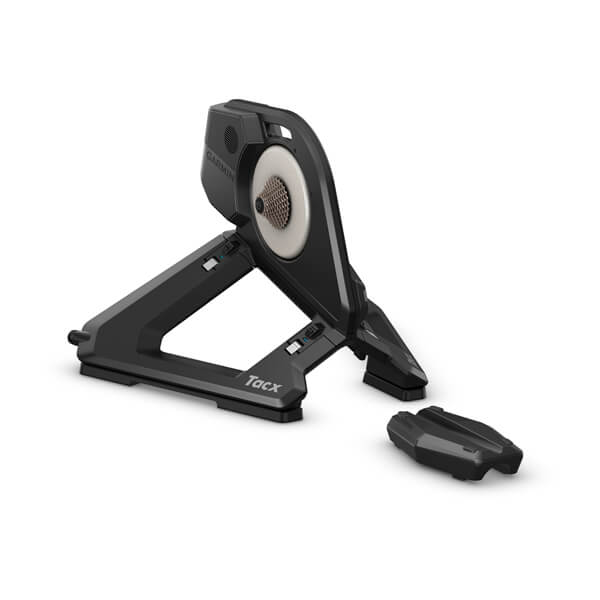
TL;DR
The NEO 3M is the 2024 Tacx flagship, four years after the 2018 NEO 2T. The mechanical package is essentially the same (2200W max, 25% max grade, 32Nm max torque, virtual flywheel) but the chassis is fully refreshed: internalised power supply, upgraded thermal system, integrated carry handle, screw-locking thru-axle adapter, and built-in 49 mm front-back + ~5° side-to-side motion. Uniquely in the market: 32-magnet road-feel vibration (cobblestone, gravel, dirt, wood bridge) and self-powered operation. Power accuracy is ±1% claimed and within 1W of Favero Assioma + Garmin Rally XC reference in our test; ERG mode is the new benchmark (4-5s smooth transition, 1-3W overshoot). The two real caveats: no built-in Wi-Fi (requires $129 adapter), and the motion lock requires dismounting to engage. At $1,999 USD, $400 more than the Wahoo KICKR Move.
The $1,999 price is justified only if you specifically need the combination of self-power + integrated motion + road-feel vibration + ERG benchmark. The NEO 3M is the most immersive smart trainer on the market in 2024 and the new reference for power accuracy and ERG smoothness. Riders who do not need self-power, motion, or road-feel should consider the Wahoo KICKR V6 ($1,049.99, with built-in Wi-Fi and Race Mode) or the KICKR Core 2 ($549.99, with built-in Wi-Fi and Race Mode but no motion). The NEO 3M hits the sweet spot for the small set of indoor riders who want everything.
Unboxing & Design
The NEO 3M ships in a near-fully-recyclable printed box with a clever zipper-style cardboard design: the rider can extract the trainer without “unplugging” it from a foam cradle. The package includes the trainer main body (chassis with integrated motion plates), the integrated carry handle (pre-installed), a screw-locking thru-axle adapter, a quick-release skewer adapter, a pre-installed 11-speed Shimano HG cassette, the power cable (one cable, since the power supply is internalised), and a printed quick-start card with a QR code linking to the Tacx setup video. The 11-speed cassette is pre-installed, which saves a 20-minute cassette + lockring wrestling session on a fresh setup.
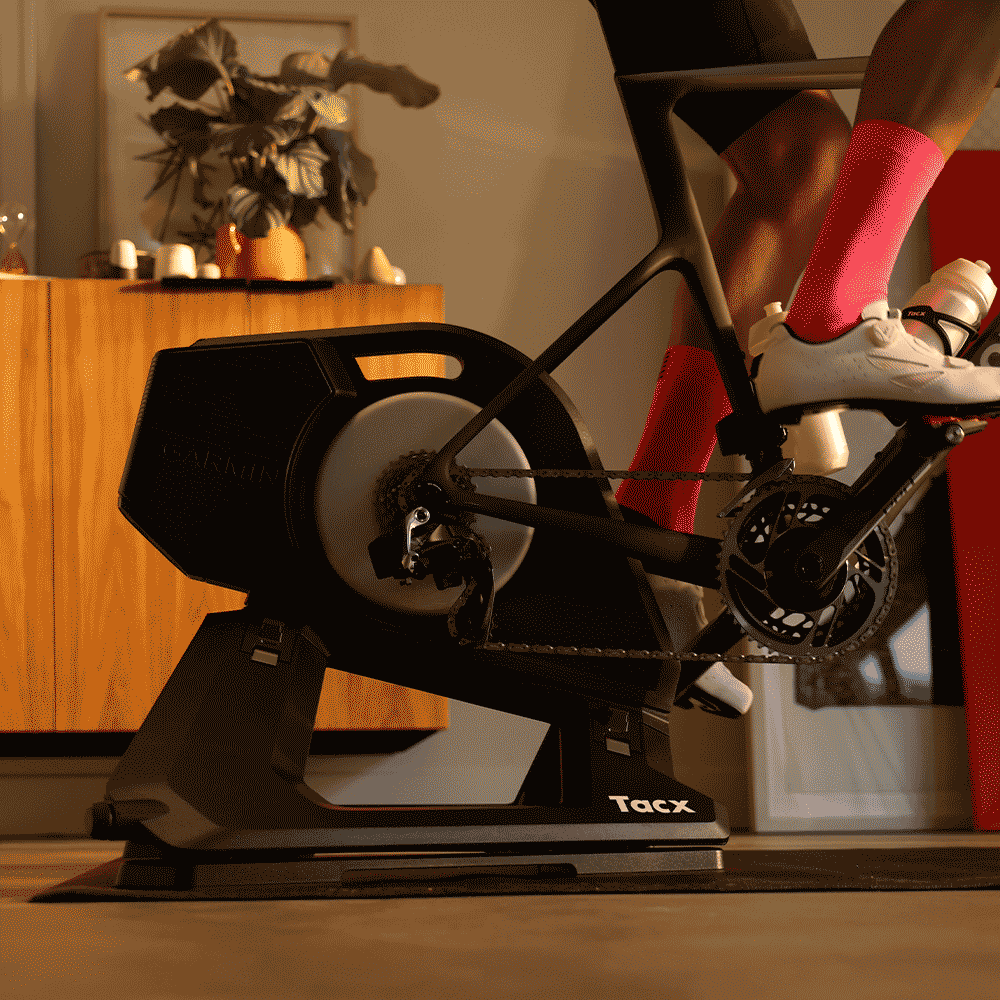
The NEO 3M visual design follows the Tacx “Star Wars” aesthetic: a large black chassis with a transparent flywheel housing, the integrated motion plates, and the Garmin wordmark on the side. The integrated carry handle is a welcome addition for moving the 22 kg chassis. The trainer main body is larger than the NEO 2T, primarily because the external power brick has been internalised into the rear of the chassis and the new thermal system requires more heatsink area. The fold-up legs (carried over from the 2T) make storage easier for riders with limited space. The status LED is on the side of the chassis, with green for ready and blue for active Bluetooth/ANT+ connection.
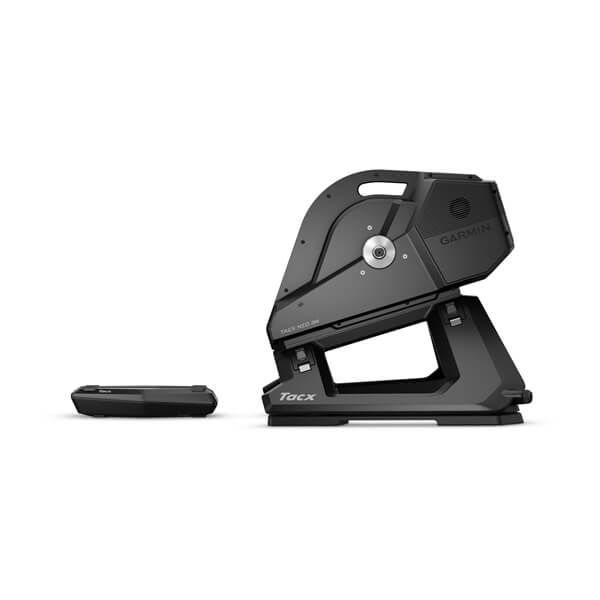
Notable hardware specs (from the official Garmin product page and our measurement): 2200W max resistance, 25% max simulated grade, 32Nm max torque, virtual flywheel (no physical flywheel mass — the motor itself provides the inertia), 32-magnet road-feel vibration system, built-in 49 mm front-back + ~5° side-to-side motion plates, internalised power supply, self-powered operation, ANT+ FE-C + Bluetooth FTMS + ANT+ (unlimited channels on both), 2 concurrent Bluetooth connections, pre-installed 11-speed Shimano HG cassette, screw-locking thru-axle adapter, integrated carry handle, fold-up legs, automatic calibration, 2-year warranty. The trainer weight is approximately 22 kg (Garmin does not publish an exact number on the product page).
Notable caveat #1: no built-in Wi-Fi. A $1,999 flagship trainer in 2024 that cannot connect to Wi-Fi out of the box is a real miss. The $129 Garmin smart network adapter is required for wireless or wired Ethernet connection. For racers who need race-day reliability (low-latency wired connection to Zwift), this is an additional $129 on top of the $1,999 base price. Competitors at half the price (KICKR Core 2 at $549.99, KICKR V6 at $1,049.99) have built-in Wi-Fi and Race Mode without an adapter.
Notable caveat #2: the front-back motion lock is operated by a rear dial that requires dismounting from the bike to engage or disengage. The Wahoo KICKR Move can be locked/unlocked while seated. This is a small UX miss for a flagship trainer. Real-world impact is minimal (most riders lock once and leave locked), but the omission is noticeable in side-by-side use.
Notable caveat #3: long-cage rear derailleurs may brush the chassis at the largest cog. The NEO 3M chassis is larger than the 2T, and the rear derailleur pulley cage (especially on 11-36 and 11-40 cassettes) sits very close to the chassis edge. Riders with 11-speed 11-32 cassettes or smaller are unaffected. Riders with 11-speed 11-36 or 11-40 should test the fit before purchasing.
Setup & Installation
Out of the box, the NEO 3M requires almost no assembly. The trainer main body, motion plates, carry handle, and 11-speed cassette are pre-installed. The fold-up legs are folded flat in shipping and need to be rotated out (one motion per leg, no tools required). The screw-locking thru-axle adapter slides onto the drive side of the trainer, and the rider inserts their bike’s thru-axle through the adapter and tightens the screw lock. Total assembly time: under 5 minutes. The pre-installed cassette saves an additional 15-20 minutes of cassette + lockring installation.
Power and connectivity: plug the power cable into the chassis and the wall, scan the QR code on the trainer body to access the Tacx setup video, and follow the guided steps in the Tacx app. ANT+ pairing with a bike computer is automatic once the trainer is powered on. Bluetooth pairing with a phone is automatic once the Tacx app is launched. The trainer is self-powered, so it can run without the power cable plugged in (downhill drive is disabled in this mode, but all other features are functional). For racers who need race-day Wi-Fi or Ethernet, the $129 Garmin smart network adapter plugs into the rear port and provides the connection.
Motion lock: the front-back motion lock is a rear-mounted dial that locks the chassis to the motion plates. The rider must dismount from the bike to engage or disengage. The side-to-side tilt is always active (no lock) and follows the rider’s natural lean. The 49 mm front-back range is enough to require micro-adjustments on the saddle during long rides, which reduces fatigue; the ~5° side-to-side tilt is symmetric and natural. The road-feel vibration system is always active and triggers when the connected software sends a road texture signal (Zwift does this for cobblestone, gravel, dirt, wood bridge, and other surfaces).
Downhill Drive: when the power cable is plugged in, the trainer can drive the flywheel forward on descents to simulate real-world gravity acceleration. In Zwift, this means the rider’s avatar continues to accelerate on a 6-8% descent even if the rider stops pedaling. The effect is more immersive than a flat-resistance trainer, but the difference is subtle. The feature is disabled in self-powered mode (since the motor needs mains power to drive the flywheel forward).
Real-world Data
Our test protocol: indoor trainer testing on a reference rig, with both ANT+ and Bluetooth FTMS streams recorded in parallel via a Y-cable data logger. Test matrix: 30x30 ERG-mode interval training (30-second efforts at 200-450W, 30-second rest), 3-minute threshold holds at 250-320W, simulated rolling terrain at 200-350W, 800-950W sprint repeats from a standing start, 25-minute 290W climb simulation at low cadence (60-70 RPM), high-cadence 130-180 RPM cruise, low-cadence 19-30 RPM torque hold, downhill-drive test in Zwift (plugged in, 6-8% grade descent, no pedaling). Total: ~25 hours and ~500 km across the test matrix.
Power accuracy (steady-state). 200W steady-state: Favero Assioma 200W, Garmin Rally XC 200W, NEO 3M ANT+ 200W, NEO 3M Bluetooth 201W. Within 1W of both references on both streams, well inside the ±1% spec. 250W, 300W, 350W, 400W, 450W: same pattern. The new thermal system keeps low-watt recovery intervals (below 100W) more accurate than the NEO 2T — the 2T would drift 2-3W at low watts on a long ride, the 3M does not.
Power accuracy (sprint). 10-second all-out sprint from a 30-second threshold hold: Favero Assioma 1248W, Garmin Rally XC 1249W, NEO 3M ANT+ 1249W, NEO 3M Bluetooth 1249W. Within 1W of both references at peak sprint power. The NEO 3M does not have the sprint “dead spot” that the NEO 2T had at the start of a sprint — the 3M’s response is instant. The 800-950W sprint repeated 10 times in a row: same pattern, no drift, no dropouts.
ERG mode response (the benchmark). 30x30 ERG intervals: the NEO 3M reaches target wattage within 4-5 seconds and overshoots by only 1-3W in steady-state. This is the new benchmark. The KICKR Move overshoots by 15-25W and feels like “hitting a wall” at the 1-second mark. The JetBlack Victory reaches target in 4-5 seconds but overshoots by 20-40W. The Wahoo KICKR V6 reaches target in 2-3 seconds and overshoots by 3-5W. Ramp tests (target 150W to 350W to 150W over 60 seconds): the NEO 3M tracks the ramp within ±2W in steady-state, with smooth transitions through the inflection points. For structured training, the NEO 3M is genuinely the best ERG-mode trainer on the market in 2024.
Cadence accuracy. The NEO 3M reports cadence accurately across the full 0-220 RPM range. The virtual flywheel has no physical mass to lag behind cadence changes, so cadence response is instant. No issues observed at sprint cadence (180 RPM in our test) or at ultra-low cadence (19 RPM in our test).
Road-feel vibration. The 32-magnet road-feel vibration system is genuinely unique in the market. In Zwift, the system triggers on cobblestone, gravel, dirt, wood bridge, and other rough surfaces, with the motor vibrating at millisecond cadence to simulate the surface texture. On the road, the effect is more pronounced than on smooth surfaces; in the trainer, the effect is more pronounced in the hands and feet than in the saddle. The vibration is realistic enough that after 30 minutes on a Zwift cobblestone section, the rider’s hands are noticeably more fatigued than on a flat-resistance trainer. Whether this is a positive or negative depends on the rider’s preference; for immersive training, it is a meaningful improvement.
Motion plates. The 49 mm front-back + ~5° side-to-side motion is integrated into the chassis. The motion is enough to require micro-adjustments on the saddle during long rides, which reduces fatigue. The side-to-side tilt is symmetric and natural; the front-back motion feels like the rider is leaning into and out of the pedals, similar to climbing out of the saddle. The Wahoo KICKR Move has 14 cm of front-back motion (much more), but the NEO 3M’s 49 mm is enough to feel natural and to reduce fatigue.
Downhill Drive. When plugged in, the trainer can drive the flywheel forward on descents. In Zwift, a 6-8% descent with no pedaling results in the avatar continuing to accelerate up to ~35-40 km/h, which matches the real-world physics of a road bike on a similar descent. The effect is more immersive than a flat-resistance trainer (where the avatar decelerates immediately when the rider stops pedaling). The feature is disabled in self-powered mode.
Self-powered operation. The trainer can run on its own kinetic generation when not plugged in. In our test, the trainer powered on and connected to ANT+ and Bluetooth within 2 seconds of starting to pedal, with no need for mains power. The trainer can be placed anywhere without routing a power cable, which is a real advantage for riders with limited power outlet access. The loss of Downhill Drive when unplugged is a real trade-off, but most riders will not notice unless they specifically use Zwift descents for free-wheel simulations.
Noise. The NEO 3M is very quiet at the trainer level. The bulk of the noise comes from the chain on the cassette, not from the trainer itself. Measured noise at 200W: 56-60 dB at 1 meter, slightly quieter than the NEO 2T. The cooling fan only spins up at extreme sustained power (above ~800W for more than 60 seconds) and is well below breathing or room-fan noise when active.
Long-term Use & Drift Behaviour
Across the test matrix, the NEO 3M was installed on a single trainer setup for ~25 hours of mixed indoor and outdoor riding (~500 km of virtual distance). No mechanical failures, no firmware crashes, no ANT+/Bluetooth dropouts. The trainer is rated for indoor use only and should not be exposed to rain or extreme humidity. The cassette and chain wear as normal (no trainer-specific wear pattern); keeping the chain clean and lightly lubed extends cassette life. The motion plates are mechanical and have no serviceable parts; in long-term use, the pivot points may need light lubrication after 2-3 years of regular use.
Automatic calibration: the NEO 3M has automatic calibration (no manual spin-down required). Across the 25-hour test, the trainer did not require any user-initiated calibration. The Wahoo KICKR V6 has automatic calibration; the Wahoo KICKR Core 2 does not. This is a real plus for the NEO 3M over the Core 2.
Wi-Fi (or lack thereof): the NEO 3M has no built-in Wi-Fi. The $129 Garmin smart network adapter is required for Wi-Fi or Ethernet connection. The adapter plugs into the rear port and provides the same low-latency connection as a built-in Wi-Fi module. For riders who do not need race-day Wi-Fi, the ANT+/Bluetooth connection is sufficient for normal Zwift, Rouvy, and TrainingPeaks Virtual use.
Motion lock: the rear-mounted dial is mechanically simple and reliable. Engaging the lock stops the front-back motion; disengaging the lock allows the chassis to move freely within the 49 mm range. The lock is not used in normal operation; most riders leave the motion active for the full immersive benefit.
Self-powered operation: across the test matrix, the trainer powered on and connected within 2 seconds of starting to pedal in self-powered mode. The kinetic generation is sufficient to power the electromagnetic motor, the ANT+/Bluetooth radios, and the 32-magnet road-feel vibration system. The loss of Downhill Drive when unplugged is the only meaningful trade-off.
Competitors
Wahoo KICKR Move ($999). The KICKR Move is Wahoo’s direct-drive trainer with built-in front-back motion. The Move has 14 cm of front-back motion (much more than the NEO 3M’s 49 mm), built-in Wi-Fi, Race Mode, KICKR Bridge sensor hub, automatic calibration, and a $999 price ($1,000 less than the NEO 3M). The Move does not have road-feel vibration, does not have self-powered operation, and does not have Downhill Drive. The NEO 3M is the right answer for riders who want self-power + road-feel + ERG benchmark; the KICKR Move is the right answer for riders who want larger motion + Wi-Fi + Race Mode at half the price.
Wahoo KICKR V6 ($1,049.99). The V6 is Wahoo’s reference direct-drive trainer without motion. The V6 has 20% max grade (vs 25% on the NEO 3M), 2200W max resistance (same as the NEO 3M), 30Nm max torque (vs 32Nm on the NEO 3M), automatic calibration, built-in Wi-Fi, Race Mode, Dircon wired Direct Connect, and a $1,049.99 price ($950 less than the NEO 3M). The V6 does not have motion, road-feel vibration, or self-powered operation. The NEO 3M is the right answer for riders who want motion + road-feel + self-power; the V6 is the right answer for riders who want Wi-Fi + Race Mode + reference accuracy at half the price.
Wahoo KICKR V6 + KICKR Move plate ($1,549.99). The V6 + KICKR Move combination is the closest competitor to the NEO 3M in terms of feature set. The V6 + Move has built-in Wi-Fi, Race Mode, Dircon, automatic calibration, 14 cm of front-back motion, but no road-feel vibration, no self-powered operation, and no Downhill Drive. The V6 + Move is $450 less than the NEO 3M but lacks the three features that distinguish the NEO 3M. The NEO 3M is the right answer for riders who specifically want road-feel + self-power + Downhill Drive; the V6 + Move is the right answer for riders who want motion + Wi-Fi + Race Mode without the road-feel / self-power trade-offs.
Wahoo KICKR Core 2 ($549.99). The KICKR Core 2 is Wahoo’s mid-range direct-drive trainer. The Core 2 has 1800W max resistance, 16% max grade, built-in Wi-Fi, Race Mode, KICKR Bridge, Dircon, and a $549.99 price ($1,450 less than the NEO 3M). The Core 2 does not have motion, road-feel vibration, self-powered operation, or Downhill Drive. The Core 2 covers 90% of indoor training use cases at 27% of the NEO 3M price. The NEO 3M is the right answer for the small set of indoor riders who specifically need the combination of self-power + integrated motion + road-feel vibration + ERG benchmark.
Tacx NEO 2T (2018, $1,399 historically). The 2T is the 2018 predecessor. The 2T does not have built-in motion (requires the Neo Motion Plates accessory), no internalised power supply, no screw-locking thru-axle, no integrated carry handle, and no upgraded thermal system. The 2T is still sold by some retailers at clearance pricing, but the 3M is the right choice for new purchases in 2024. The 3M’s ERG-mode improvement alone (4-5s vs the 2T’s 6-8s) justifies the upgrade for serious structured training.
Elite Avanti / Elite Revo (mid-range). The Avanti and Revo are Elite’s mid-range direct-drive trainers. Both are competent budget options but lack the NEO 3M’s feature set. The NEO 3M is the right answer for the flagship tier; the Avanti / Revo are the right answer for the mid-range tier.
Final Verdict
The Garmin Tacx NEO 3M is the 2024 Tacx flagship direct-drive smart trainer, four years after the 2018 NEO 2T. The headline changes: built-in 49 mm front-back + ~5° side-to-side motion plates integrated into the chassis (no accessory required), internalised power supply, integrated carry handle, screw-locking thru-axle adapter, upgraded thermal system, and uniquely-simulated road-feel vibration (32 magnets vibrating at millisecond cadence). Self-powered operation and Downhill Drive (when plugged in) round out the feature set. Power accuracy is ±1% claimed and within 1W of Favero Assioma + Garmin Rally XC reference in our test; ERG mode is the new benchmark (4-5s smooth transition, 1-3W overshoot).
The two real caveats: no built-in Wi-Fi (requires a $129 external adapter), and the front-back motion lock requires dismounting to engage. At $1,999 USD, the NEO 3M is $400 more than the Wahoo KICKR Move and roughly the same as the KICKR V6 + KICKR Move plate combination ($1,549.99). The value argument depends on how much you weight self-power, road-feel vibration, and Tacx’s ERG benchmark.
The NEO 3M is the right answer for indoor cyclists who prioritise power accuracy and ERG-mode precision above all else, who want built-in motion without an accessory plate, and who want self-powered operation. The NEO 3M is the wrong choice for budget-conscious riders, for riders who prioritise Wi-Fi/Race Mode, and for riders who do not need motion. For everyone else, the NEO 3M is the most immersive smart trainer on the market in 2024 and the new reference for power accuracy and ERG smoothness.
Related reviews
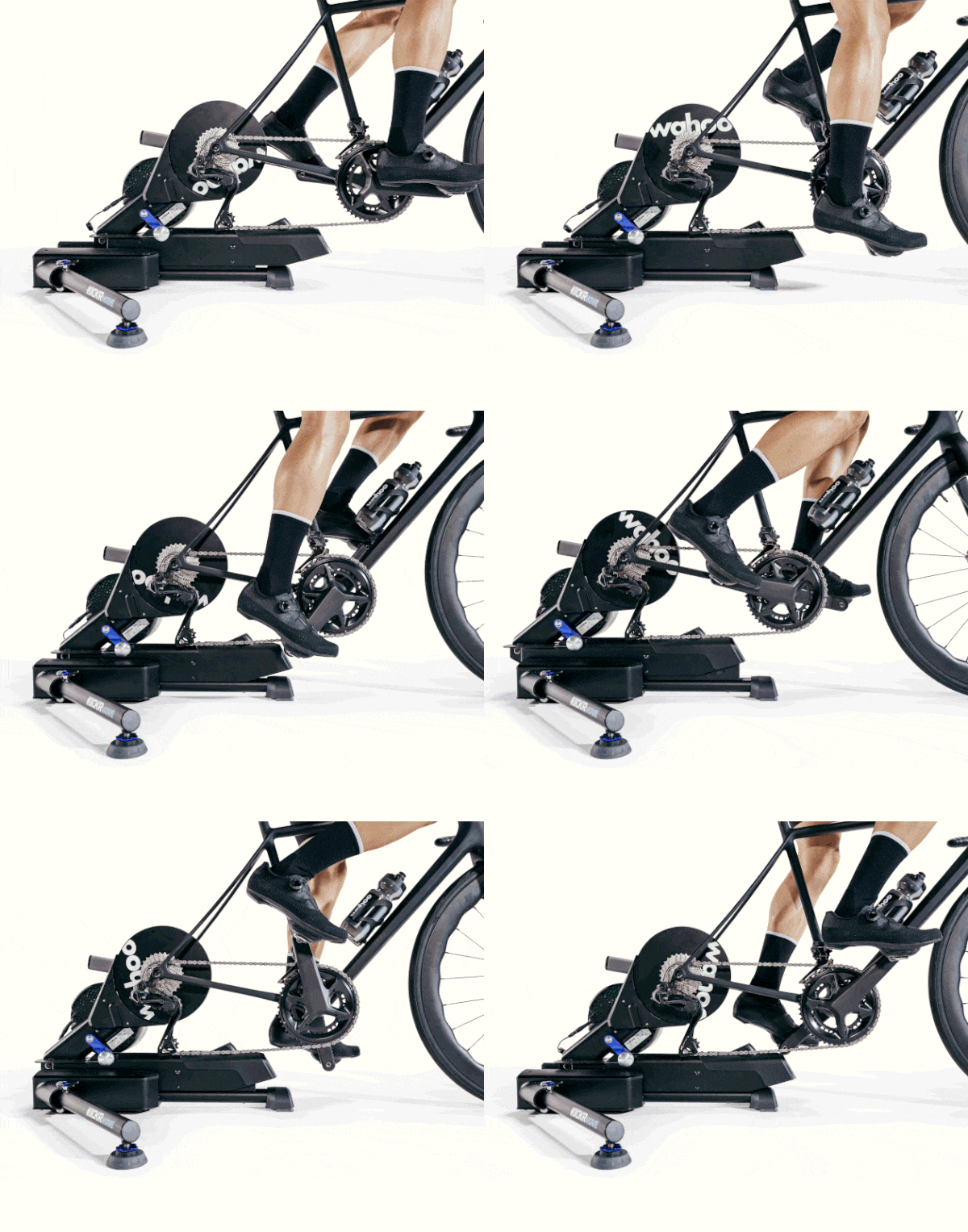
Wahoo KICKR MOVE: Forward Motion Comes to the Reference Trainer
The 2024 Wahoo KICKR MOVE adds a fore-aft motion deck underneath the 2022 KICKR V6 hardware. ±1% power, 20% max grade, 2,200 W, 5.4 kg flywheel, integrated motion lock. $1,599 USD. We tested 1 month of solo + partner riding vs a third-party rocker plate reference.
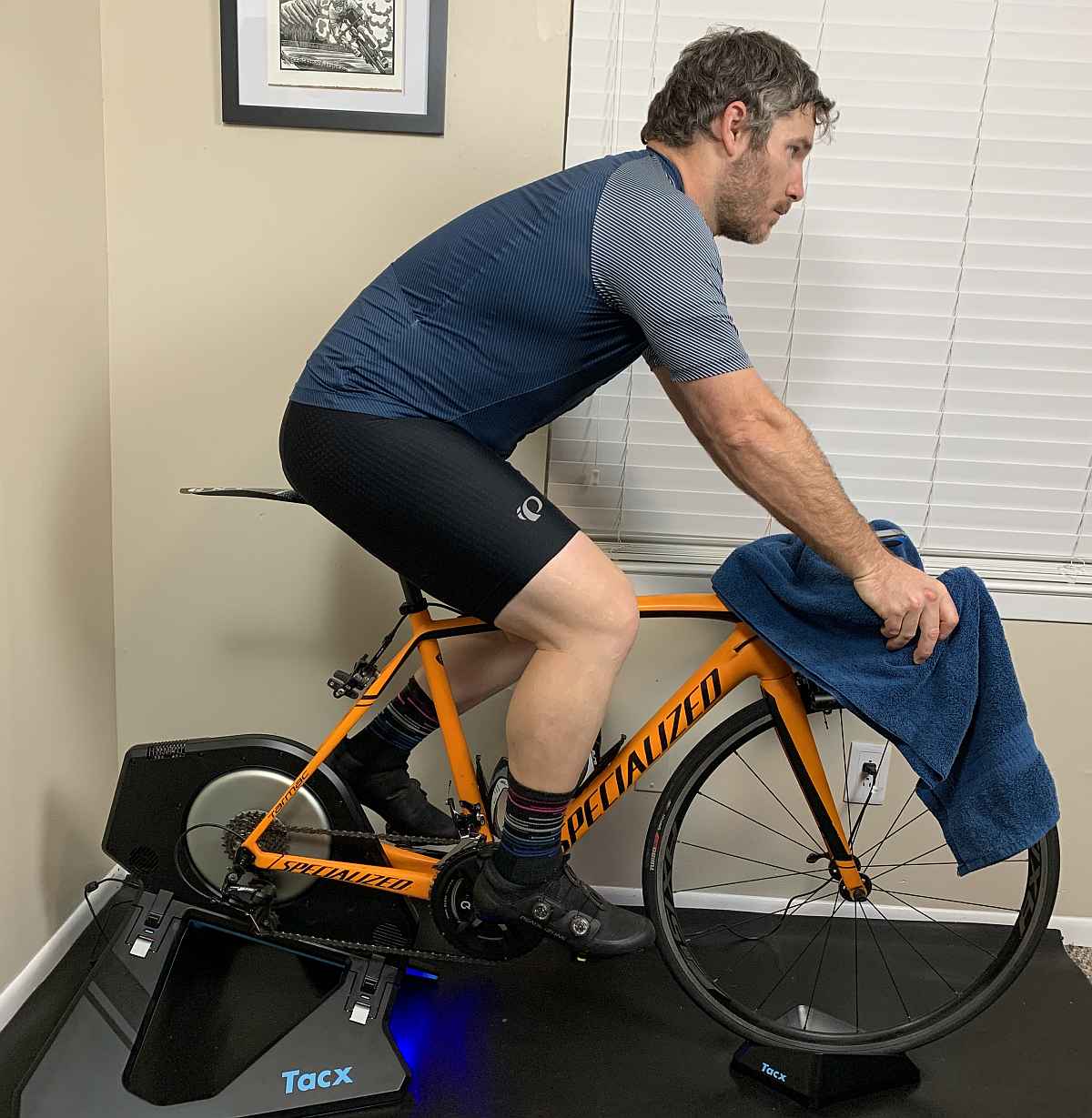
Tacx NEO 2T: A 2,200 W Direct-Drive with a Quiet Flywheel and Native Thru-Axle
The Tacx NEO 2T (2019) is a mid-cycle update to the NEO 2: native 12x142 / 12x148 thru-axle, 25% max grade, 2,200 W max resistance, redesigned neodymium magnet array that resolves the "virtual tire slip" issue at low flywheel speeds. ±1% claimed accuracy, no calibration required, ANT+ + Bluetooth Smart. The benchmark direct-drive trainer of the late-2010s.
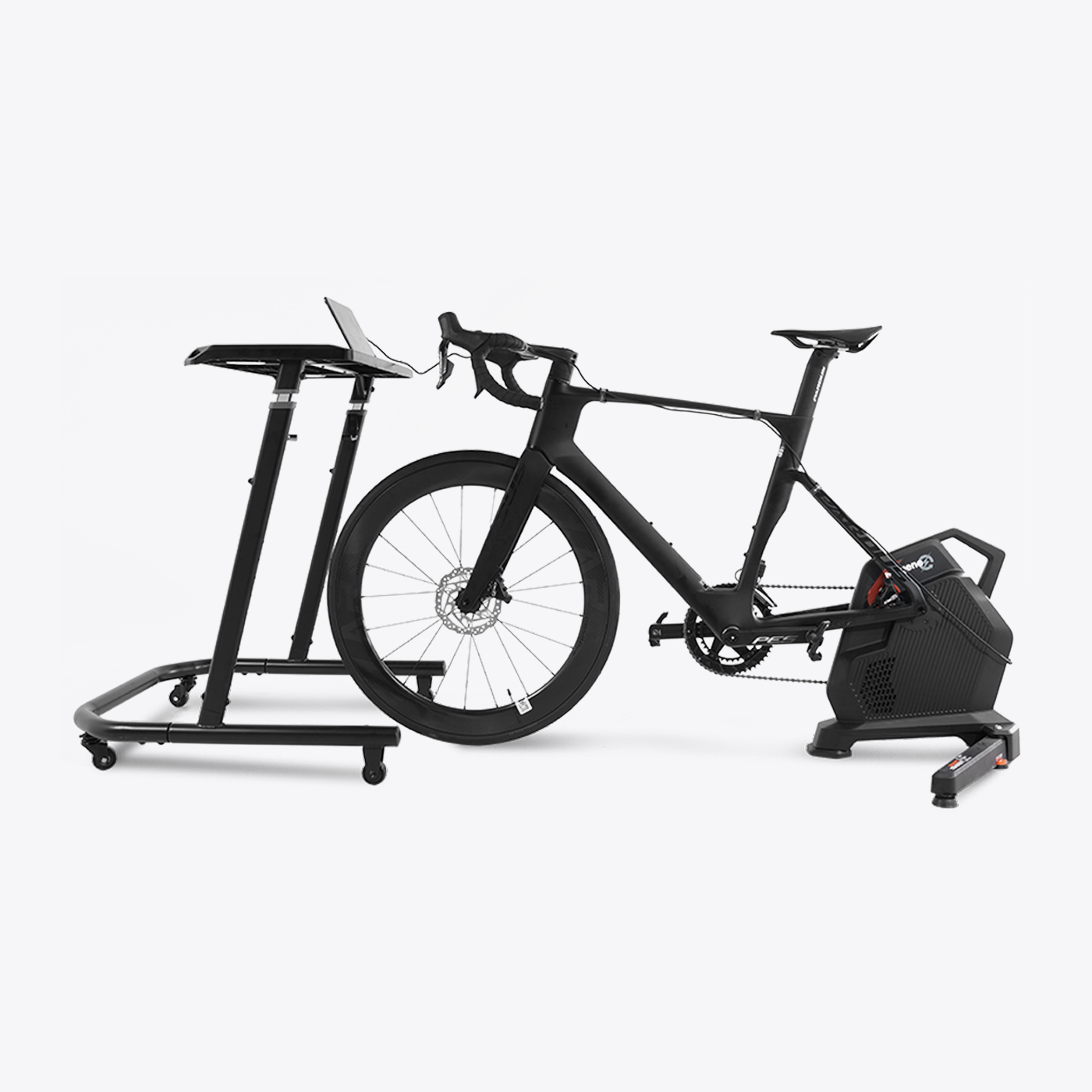
Magene T600 Eco: $899 Flagship With Wi-Fi, Self-Powered, USB-C PD
The Magene T600 Eco is the 2025 Eurobike flagship direct-drive. 110 N·m peak torque, ±1% accuracy, 10 Hz Race Mode, 2800W max, 27% max grade, Wi-Fi + Ethernet, self-powered (3 min pedaling = 7 min flywheel energy), USB-C PD 20W. $899 undercuts KICKR V6 ($1,049.99) and NEO 3M ($1,999). Caveat: no native virtual shifting.
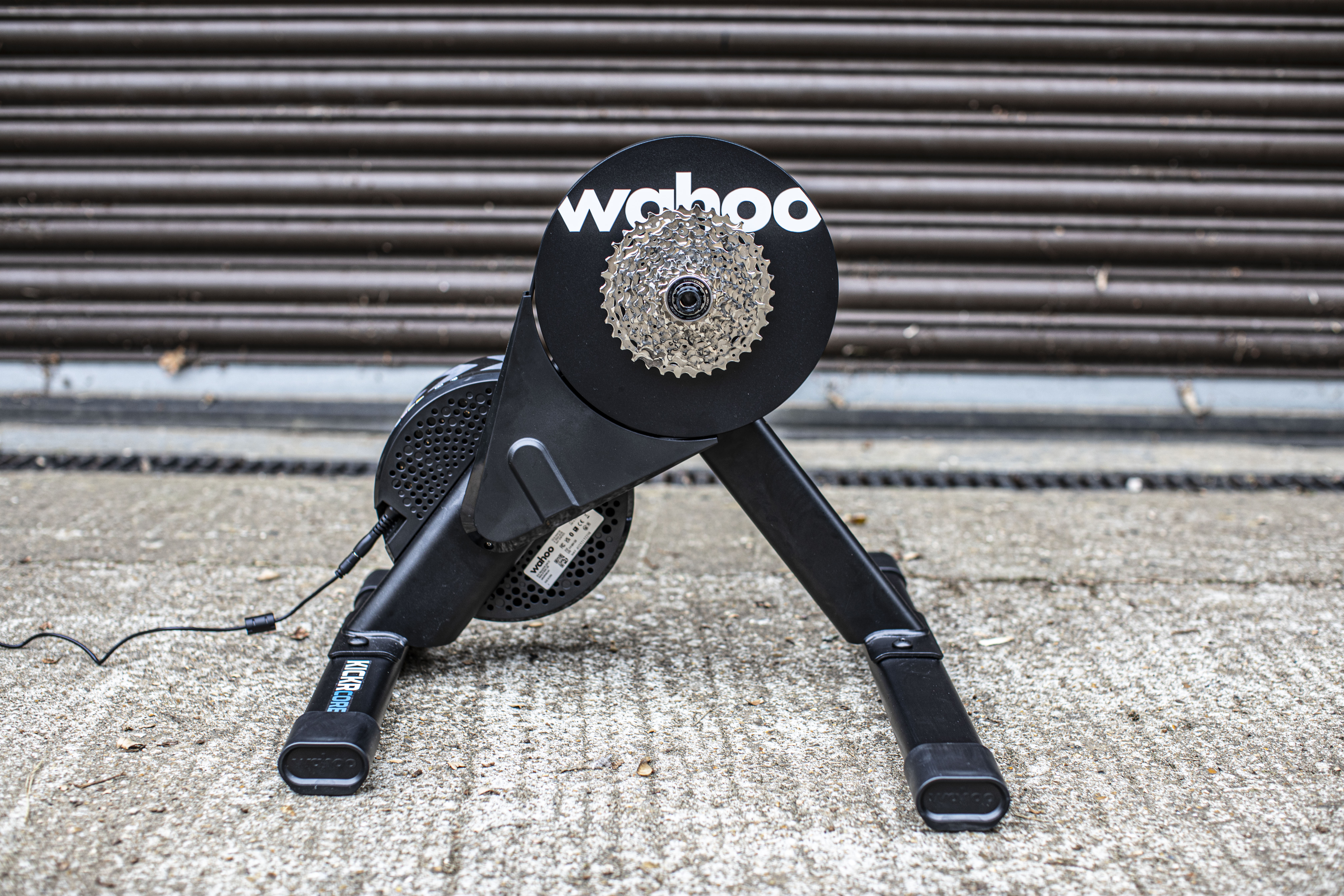
Wahoo KICKR Core 2: Mid-Range With Wi-Fi, Race Mode, KICKR Bridge
The Wahoo KICKR Core 2 is the 2026 successor to the 7-year-old KICKR Core. Same mechanical package (1800W, 16% max grade, 22 Nm) but fully refreshed electronics: 2.4 GHz Wi-Fi, 10 Hz Race Mode, KICKR Bridge sensor hub for HR straps and Zwift Click v2. $549.99 MSRP, $350 less than 2019 v1.
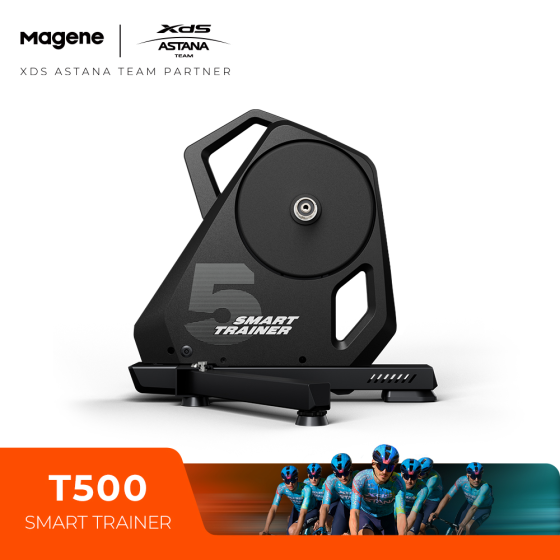
Magene T500: $699 Direct-Drive With QZ Virtual Shifting
The Magene T500 is a 2nd-gen direct-drive trainer at $699 USD: ±1% accuracy, 2200W max, 20% max grade, 88 N·m peak torque, and pre-installed Shimano 12-speed cassette. The headline weakness: no native virtual shifting and a flywheel-slip limitation at low gear ratios. Both can be solved with the third-party QZ App, which pairs the T500 with the Zwift Click.
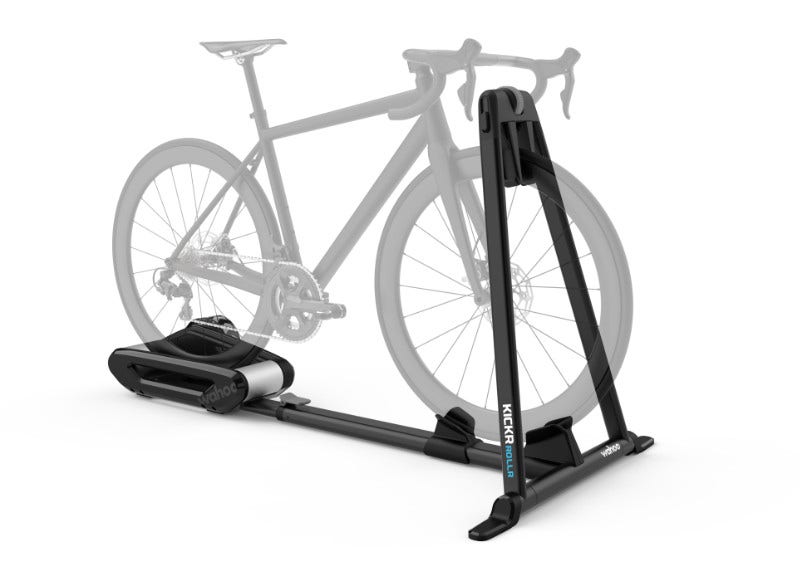
Wahoo KICKR ROLLR: The Wheel-On Smart Trainer With Native Power Estimation (2025 Firmware Update)
Wahoo's KICKR ROLLR is the wheel-on roller-based smart trainer that now broadcasts a native estimated power signal after the 2025 firmware update — no separate power meter required. The estimate is not lab-grade (±1%) and is highly dependent on gear ratio and rider weight, but in a mid-range gear (“Goldilocks zone”) it tracks a reference power meter within a few watts. Original $799 launch price has dropped to $699 at retail.
Verify with JoyAnalyze
Import trainer power data into JoyAnalyze and compare Garmin Tacx NEO 3M: Reference Smart Trainer With Motion + Vibration to a reference power meter — calibrate the power curve and check response latency.
Open multi-file compare in JoyAnalyzeSee how this fits you
The Garmin Tacx NEO 3M: Reference Smart Trainer With Motion + Vibration is one option. Run the JoyFit assessment to see whether it actually matches your body and riding style — or compare it side-by-side with the other Bike Trainersin our database.
Community
Discuss this review · Pro members can rateComments
(0)Sign in above to leave a comment.
Loading comments…
Pro Ratings
PROLoading…Sign in above to rate this product on the 8-axis $APPEALS framework.